Press Release: Hybrid Cars To Be Banned From 2035

The Government plans to ban sales of new hybrid cars from 2035 along with all petrol and diesel cars. That has been brought forward from the previously planned date of 2040 and will now include hybrid vehicles.

We deplore this over-reaction to the views of the extreme end of the environmental movement. This change in the regulations ignores the whole-life cost in terms of carbon emissions of building, operating and scrapping vehicles. Premature changes will mean more emissions of CO2 not less.

There is also no certainty that by 2035 there will be vehicles available that provide sufficient range, or an adequate network of electric charging points that drivers can rely upon. It will also require a major expansion of the electricity grid to cope with the increased demand. All these changes will impose enormous costs on drivers and the economy, and threaten the very existence of the motor manufacturing industry.

Hybrid vehicles are a good compromise solution to meet the concerns of drivers and ensure that they transition to lower emission vehicles in due course, but this change might actually deter people from buying them. Bringing in tougher regulations might simply ensure that vehicle owners keep their old petrol/diesel vehicles for longer rather than replacing them with new ones, with the unintended consequence that emissions will not fall.

These proposals are part of the Government’s plans to achieve a net-zero carbon target by 2050 which will impose enormous costs on the economy and have no impact on the worldwide emissions. The UK is already a very small part of worldwide emissions and unless major nations such as China and the USA cease using coal in power stations, when they are currently building more of them, there will be negligible impact.

This latest announcement is just another example of “gesture politics” that may kowtow to the whims of environmental enthusiasts in the UK but will in reality have negligible impact apart from inconveniencing the general public.

Safer Speeds – The Real Data

I have commented before on how Transport for London (TfL) have failed to justify their “Safer Speeds” proposals which includes imposing 20 mph speed limits on many roads. We have previously pointed out how TfL have been misinterpreting police accident data to support their claims that the measures are justified.

For example, they issued a Tweet that said “speed accounts for 37% of all death and serious injuries” in road accidents in London. That figure is simply wrong. The claim was allegedly based on the STATS19 data reported by the police (a form they fill out about every accident involving injuries).  That form allows for multiple factors to be recorded and after submitting a Freedom of Information Act request we learned that they counted all the accidents where factors 306, 307 and 602 were noted.

But factor 602 is described as “Driver/rider either behaved in a negligent or thoughtless manner or was in a hurry….”. Clearly the key word in that sentence is the second “or” when TfL have interpreted it to mean “and”.  There is no basis for claiming that all accidents where factor 602 is attached were rated by the police as ones where a driver was in a hurry. They might have simply been careless. Only where the other factors 306 or 307 were also noted could there be any claim that speed was a factor in the accident.

We now have the complete accident data and the data makes it plain that exceeding the speed limit (factor 306) is a very minor factor in KSIs (Killed and Serious Injuries) in London. It’s actually recorded as a contributory factor in only 5.9% of such accidents in the last five years. That’s actually less than the figure of 7.1% reported by the Department for Transport for the national figures in 2018 – see table below. Clearly tougher enforcement of speed limits is therefore unlikely to have much impact on the overall numbers. That of course is particularly so in London where average traffic speed is typically well below the speed limit.

Contributory Factors and Speed - ras50008

The largest contributory factor by far is “Failed to Look Properly” which accounted for 42% of KSIs in London or 35% nationally. But there are several other factors with higher ratings than “Exceeding the Speed Limit” such as “Poor Turn or Manoeuvre”, “Failed to Judge Other Persons Path…”, “Loss of Control” and “Careless, Reckless or in a Hurry”.

Even if you bundle factors 306 and 307 together only 12% of KSI incidents are included nationally so reducing speed limits is going to have only a small contribution at best to reducing such accidents. It’s reducing the other factors that is the key to substantially reducing road casualties. More driver education, improved roads and research into saccadic masking may be productive.

Note also that a lot of the reported factor 306 and 307 claims of excessive speed and speed above the speed limit might well involve illegal use of vehicles such as stolen vehicles so reducing speed limits will have negligible impact in reality.

There is simply no cost/benefit justification for the Safer Speeds proposals as pointed out in our previous article and TfL have clearly been abusing the data so as to make spurious claims.

Roger Lawson

Twitter: https://twitter.com/Drivers_London

You can “follow” this blog by clicking on the bottom right.

Hayes Neighbourhood Scheme and Carbon Emissions in Bromley

Last week (29/1/2020) I attended a meeting of the Environment Policy Development and Scrutiny Committee of the Bromley Council. There were a couple of items worth mentioning:

A Local Neighbourhood Improvement scheme for Hayes Village was discussed and there were a large number of questions from members of the public (in fact more than could be fitted in). This scheme originally included a wide-area 20 mph zone but has been revised to reduce that to a smaller area.

In response to a question, Portfolio Holder Councillor Huntington-Thresher said that it was not a downgraded scheme but simply the best that could be provided for the money available. The proposal will have strong self-enforcing measures and a consultation will be conducted with local residents who can also engage with their local councillors. He also said it was the most cost-effective scheme but the junction at Ridgway will be reviewed. Councillors on the Committee supported the revised proposals.

Comment: Bromley Council as usual have made a wise decision not to waste money on a wide-area signed-only 20 mph which we know has no road safety benefit based on Government commissioned research. This is unlike neighbouring Lewisham Council who have 20-mph limits everywhere and speed humps also. We now have a web site covering our latest campaign against road closures in Lewisham which is yet another anti-car measure they are imposing – see:  https://www.freedomfordrivers.org/lewisham.htm

Another item discussed at the Bromley Committee was their adopted strategy to implement net zero carbon by 2029. The Council’s budget for this item is £134,000 but there was criticism from a member of the public that only Scope 1 and 2 emissions were covered, not Scope 3. The former only cover direct emissions whereas Scope 3 covers indirect emissions such as those made by suppliers or of staff travel to work both of which the council may have little control over. Even if Scope 3 was included it seems the impact on emissions in Bromley would be negligible.

In effect the Council is apparently being attacked on that item and the Hayes Village scheme by a combination of left-wing political activists and environmental campaigners. They surely do not represent the vast majority of the residents of the borough of Bromley.

Roger Lawson

Twitter: https://twitter.com/Drivers_London

You can “follow” this blog by clicking on the bottom right.

E-Scooters May Be Permitted on Roads

E-ScooterBoth the Times and Daily Mail have run stories that the Government may permit electric scooters to be used on both roads and cycle paths. At present they are illegal except on private land. E-scooters can travel at up to 30 mph although there is a suggestion that they might be legally limited to 15 mph. The Government is intending to undertake a public consultation on the subject in the near future.

Comment: There certainly needs to be some regulations put in place about their use and to clarify the law. At present the fact that they are currently illegal to use on roads or pavements is widely ignored in London. There has already been one death to an E-Scooter rider in London (Emily Hartridge last year), and in those countries/cities where they have proliferated there are numerous injury accidents – for example there were 1,500 injuries involving them in the USA in 2018 and there have been several deaths in Paris.

As a frequent pedestrian in London this writer is already concerned about the number of cyclists who ride on the pavement. They can come up on you from behind silently and at speed and who wants to be hit by anyone or anything travelling at 15 mph or faster without warning? The elderly are particularly vulnerable as they can have bones broken or other injuries from which they cannot easily recover. This is a frequent complaint from pedestrians in central London who attend consultative meetings.

Mixing e-scooters with traffic might be dangerous as many riders do not wear crash helmets. But perhaps it’s no more dangerous than cyclists? However it surely would be a good idea to require licensing and insurance of all electrically assisted vehicles – both e-scooters and e-cycles. This would at least help to ensure reasonable standards of behaviour from such vehicle users.

Mixing e-scooters with pedestrians on pavements where the speed differential is so large is surely dangerous unless they were limited to 7 or 8 mph, but allowing them in cycle lanes should be acceptable even if cyclists may not be too keen on the idea.

There is also a question of whether e-scooters meet a need that is not currently satisfied. Users of e-scooters often use them for commuting quite long distances (many can do 20-mile trips or even longer before expiring). They can be cheaper than cycles, certainly than e-bikes, and are obviously easier to store as they take up much less space. So they do provide a very low cost option as an alternative to cycles or using public transport.

One aspect to bear in mind is that where they are permitted there are rental companies set up who offer a pick-up and drop-off anywhere service. This has meant that they get abandoned all over the place and have become somewhat of a public nuisance. This area would certainly need specific regulation.

What do readers think? You will be able to give your views to the public consultation no doubt but post your comments below if you have any.

Twitter: https://twitter.com/Drivers_London

You can “follow” this blog by clicking on the bottom right.


TfL Misleads on Safer Speeds

I have commented before on how Transport for London (TfL) have failed to justify their “Safer Speeds” proposals which includes imposing 20 mph speed limits on many roads – see https://tinyurl.com/rlz4pa5. But we have now discovered that TfL have been misinterpreting police accident data to support their claims that the measures are justified.

For example, they issued a Tweet that said “speed accounts for 37% of all death and serious injuries” in road accidents in London. That was apparently based on the STATS19 data reported by the police (a form they fill out about every accident involving injuries).  That form allows for multiple factors to be recorded and after submitting a Freedom of Information Act request we learn that they counted all the accidents where factors 306, 307 and 602 were noted.

But factor 602 is described as “Driver/rider either behaved in a negligent or thoughtless manner or was in a hurry….”. Clearly the key word in that sentence is the second “or” when TfL have interpreted it to mean “and”.  There is no basis for claiming that all accidents where factor 602 is attached were rated by the police as ones where a driver was in a hurry. They might have simply been careless. Only where the other factors 306 or 307 were also noted could there be any claim that speed was a factor in the accident.

We now have the complete accident data to enable us to work out what the correct figure is, but it is likely to be very much lower. We will advise in due course as it will take some time to analyse the data.

Note also that a lot of the reported factor 306 and 307 claims of excessive speed and speed above the speed limit might well involve illegal use of vehicles such as stolen vehicles so reducing speed limits will have negligible impact in reality.

There is simply no cost/benefit justification for the Safer Speeds proposals as pointed out in our previous article and TfL have now been found to have been fiddling the figures to make spurious claims.

Twitter: https://twitter.com/Drivers_London

You can “follow” this blog by clicking on the bottom right.


The Population Growth Problem and Trump at Davos

7.7 Billion and Growing. That was the subtitle of a BBC TV Horizon programme last night on population. Chris Packham was the presenter. He said the world’s population was 5 million 10,000 years ago but by 2050 it is forecast to be 10 billion. He showed the impact of excessive population on biodiversity and on rubbish generation with lots of other negative impacts on the environment. It is surely one of the most important things to think about at present, and will have major economic impacts if not tackled.

The big growth is coming in countries such as Brazil and Nigeria. Sao Paolo is now 5 times the size of London and it’s running out of water. So are many other major cities including London. The growth in population is being driven by better healthcare, people living longer but mainly via procreation. A stable population requires 2.1 babies per family, but it is currently 2.4. In Nigeria it’s 5!

In some countries it is lower than that. It’s 1.7 in the UK (but population is growing from immigration) and it’s 1.4 in Japan where an ageing population is creating social and economic problems.

The FT ran an editorial on the 14th of January suggesting population in Europe needed to be boosted but it received a good rebuke in a letter published today from Lord Hodgson. He said “Global warming comes about as a result of human activity, and the more humans the more activity.  This is before counting the additional costs of the destruction of the natural world and the depletion of the world’s resources. In these circumstances suggesting there is a need for more people seems irresponsible”.

I completely agree with Lord Hodgson and the concerns of Chris Packham. The latter is a patron of a campaigning charity to restrain the growth in population called Population Matters (see  https://populationmatters.org/ ). Making a donation or becoming a member might assist.

For a slightly different view in Davos President Trump made a speech decrying the alarmist climate views and saying “This is a time for optimism, to reject the perennial prophets of doom and their predictions of the apocalypse”. He was followed by a 17-year old with limited education who said just that and got more coverage in some of the media. I believe Trump and moderate environmental writers like Matt Ridley who suggest we can handle rises in world temperature and that the future is still rosy. But we surely do need to tackle the problem of a growing world population.

Too much population has a direct impact on air pollution and traffic congestion in London and the rest of the UK. More people means more vehicles – not just cars and buses but for delivery of goods.

Chris Packham reported how population reduction was done somewhat too aggressively in India and China but there are other ways to do it via education and financial incentives. Just ensuring enough economic growth in poorer countries will reduce population growth to the minimum. Let’s get on with it!

Roger Lawson

(Twitter: https://twitter.com/Drivers_London  ).

You can “follow” this blog by clicking on the bottom right.


Lewisham Closing Roads for “Healthy Neighbourhoods”

The London Borough of Lewisham is proposing to close roads in a number of areas as part of a programme to reduce traffic and promote “healthy neighbourhoods”. There has been minimal public consultation on these proposals which would cause enormous inconvenience to local residents, visitors and delivery drivers apart from causing congestion on other roads.

The first area they plan to cover is Lewisham and Lee Green where road closures will be installed on a “trial” basis soon but other areas they propose to cover are East Sydenham, Telegraph Hill and Bellingham. See https://tinyurl.com/yy9t92gn for more background information. Such schemes are of course a part of the Mayor of London’s Transport Strategy to get us all walking, cycling and using public transport and prejudicing those who wish to use motor vehicles of any kinds. We are likely to see similar proposals from other London boroughs – at least those of a similar complexion to Lewisham who are very much against all road vehicles.

More details of the proposals for Lewisham and Lee Green are present here: https://streetbuilder.io/lewishamandleegreen/site/proposals . Note the proposals to close Manor Lane, Manor Park and Upwood Road which would be particularly inconvenient. The latter would also affect residents who live in the Borough of Greenwich who have not been consulted.

Residents of these boroughs who are likely to be affected by these proposals should certainly contact their local councillors and there is a “public drop-in event” on the 6th February, 1-8pm, Good Sheppard Church Hall, Handen Road, SE12 8NR where you can tell council officers what you think about the plans. There are also email addresses you can send in objections to in the first link given above and there is a meeting in Lee Green on the 11th February – see details here:

http://councilmeetings.lewisham.gov.uk/mgMeetingAttendance.aspx?ID=5740

We will be making objections to these plans but local residents need to do so also!

Roger Lawson

Twitter: https://twitter.com/Drivers_London

You can “follow” this blog by clicking on the bottom right.

Building on Station Car Parks

One of the items I overlooked when discussing the TfL Business Plan in a previous blog post was the proposal to build on car parks owned by TfL. There is obviously a high demand for more housing in London and TfL control a significant amount of land so it is not unreasonable to look at whether some of it could be used for housing. However building on station car parks would remove a very useful facility and cause great problems for many people who use them as part of a commuting strategy. To quote from TfL’s Business Plan:

“Working with Grainger plc, we have launched Connected Living London, a ground-breaking new partnership. Together, we are delivering one of the UK’s biggest Build to Rent programmes, with 3,000 homes being built across seven sites. Arnos Grove, which will be one of the first sites we submit to the Local Planning Authority, will see us transform a car park into around 150 good-quality rental homes – 40 per cent of which will be affordable. Not only will we provide the homes London desperately needs, but by developing on car parks, like Arnos Grove and Cockfosters, we will be promoting active and sustainable travel in line with the Mayor’s Transport Strategy”.

In respect of the Cockfosters proposals, there is a consultation you can give your views to here: https://www.givemyview.com/cockfosters/ , or for Arnos Grove here: https://www.givemyview.com/arnosgrove/ . The questions are biased in that there is no option to respond “do nothing” but you can still make your views clear.

People affected by these proposals could also object to the Planning Applications once they are made. See Enfield and Barnet council planning systems.

There are also petitions on Change.org against the Cockfosters proposal – see https://www.change.org/p/sadiq-khan-stop-cockfosters-station-car-park-development-to-keep-crucial-facilities-in-our-area and here for Arnos Grove: https://www.change.org/p/sadiq-khan-let-s-stop-tfls-proposed-development-of-the-car-parks-at-arnos-grove-station

Roger Lawson

Twitter: https://twitter.com/Drivers_London

You can “follow” this blog by clicking on the bottom right.

TfL Business Plan and Budget for the Next 5 Years – More of the Same

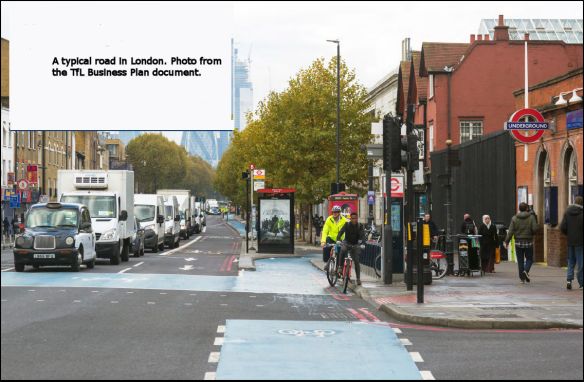
London Road

Transport for London (TfL) have published their Business Plan to cover the next 5 years and a Budget for the next year. The latter has already been approved by the London Assembly.

I shall pick out a few key points from these long documents which are certainly worth reading if you have the time – see https://tfl.gov.uk/corporate/publications-and-reports/business-plan .  Bear in mind that as always, it’s money that drives the political and policy decisions – in this case the apparent desire of the Mayor to build a bigger empire and control more of our lives. So private transport will be discouraged and he wants more money from central Government and from Londoners to fix his self-inflicted budget problems caused by fare freezes, Crossrail delays and reckless expenditure on cycle infrastructure.

The delays to Crossrail and its rising cost run through the whole document like an albatross around the Mayor’s neck. Crossrail is now unlikely to open until 2021 which means £750 million in lost revenue as against that expected, hitting the TfL budget. In addition the delays and extra work means extra costs of up to £650 million and it’s not clear where that money will be coming from. There are very optimistic forecasts in the Business Plan for income from Crossrail – for example £884 million in 2023/24. Will it really be achieved?

Diesel Buses, one of the major sources of air pollution in the capital, are to be replaced to a large extent by 2,000 zero-emission buses by the end of the 5-year business plan period, but the whole fleet will not be zero-emission until 2037. However they will be at least Euro VI compliant soon. There is also a commitment to install 300 rapid Electric Chargers for other vehicles by the end of 2020.

Note that the London bus network has been reduced partly due to falling passenger numbers and income no doubt but there is also a reduction in central London offset by increases in outer London.

TfL Transport Commissioner Mike Brown reiterates the commitment to Vision Zero to reduce road casualties despite the fact that the policy has had negligible impact to date – see a previous blog post on that subject. He also commits to tripling the amount of “protected” Cycling space which will mean more underused cycle lanes. But he is also committing to make 73 junctions safer which may assist cyclists.

Despite cutting operating costs, one of the few good things reported, there will be deficits of £307m, £493m and £513m in TfL (after “capital renewals”) for this year and the two following ones and barely break-even in 2022/23. As a result the Mayor will have to substantially increase borrowing to cover that and large amounts of capital expenditure for both Crossrail and other network improvements. That includes £2.2 billion this year and next year, followed by £1.2 billion each year in subsequent years. Total borrowing will reach £12.3 billion within 2 years. None of this is being spent on the road network of course other than some maintenance.

So far as the road network is concerned, the maintenance of road surfaces including the repair of pot-holes has been reduced in the last two years which the documents concede has caused a deterioration in road assets. However there is a commitment to “gradually restore the condition of highway assets, with a focus on those that contribute more to walking, cycling and public transport” whatever that means. Does that mean they will fund repairs to bus lanes but not the rest of the road?

On Hammersmith Bridge whose closure is causing major problems in West London, the document only says that £25 million has been allocated to pay for preliminary work but no contract will be awarded to repair the bridge until Spring 2020 and it might take several years to complete the work. It is unclear where the money required will come from. The Rotherhithe Tunnel will be refurbished within the next 5 years – cost of around £140 million, and work done on the A40 Westway. Work on the Silvertown Tunnel should commence in 2020 and complete by 2025.

As regards the ULEZ, the Budget document finally discloses some financial figures. In 2018/19, the ULEZ will contribute most of the £215 million improvement in operating income in the current year, but with implementation costs of £58 million, i.e. a net £157 million which is somewhat more than previously forecast (see   https://tinyurl.com/y4w6pwuk ). As the Budget document only covers the year 2019/20 and no details are provide in the Business Plan the impact of the extension of the ULEZ to the North/South Circular is not apparent but the Mayor clearly intends to push ahead with that (assuming he gets re-elected).

The Business Plan indicates that fares income is expected to rise at around RPI which ignores the fact that Sadiq Khan has already promised to continue to freeze public transport fares if he gets re-elected, at least for 2020. So the Business Plan may be totally unrealistic.

In summary the Business Plan and Budget demonstrate an incompetent Mayor and senior management at TfL who wish to get us all cycling, walking or using public transport while the road network gets worse. This results in more traffic congestion and more air pollution which most Londoners would prefer them to fix. The persistent financial mismanagement by the Mayor will also come home to roost sooner or later.

A good example of the result of his policies is actually shown in a photograph of an east London street in the Business Plan document. A long queue of traffic in one lane with the bus lane unused and few cyclists in the cycle lane! See above.

Roger Lawson

Twitter: https://twitter.com/Drivers_London

You can “follow” this blog by clicking on the bottom right.

Reporting a Road Incident to the Met

The Metropolitan Police have had a useful web site for reporting a crime or road accident for some time – see https://www.met.police.uk/ , where is not an emergency. It’s very easy to use and saves you having to visit a police station. They also now seem to have added a specific page to enable you to report a road incident and upload some dashcam footage – see:  https://www.met.police.uk/dashcam

But one person said on Twitter: “Can someone explain why I can film freely with a dashcam but to put a CCTV camera in a public space I have to jump through various legal hoops under the Surveillance Camera Code of Practice issued “to ensure that the use of cameras is only used in pursuit of a specified purpose”.

That’s a good question. A quick review tells me that this is a complex area of regulations. The use of video cameras is governed by two bodies – the Information Commissioner (ICO) who lays down guidelines, and the Surveillance Commissioner who regulates Police Forces and Local Authorities but their guidance is only advisory for other organisations so far as I can see.

But the ICO barely seems to be keeping up with technology. For example they say “The ICO recommends that users of drones with cameras should operate them in a responsible way to respect the privacy of others” and not much more.

In essence I conclude that a dashboard camera (dashcam) is no different to using any other kind of camera in a public place and hence is not subject to regulation except that any photographs that may contain personal information need to be stored securely and other data protection rules apply.

But a fixed video camera that covers a public place (e.g. a street outside your house) is subject to guidelines issued by the ICO and unless there is a justifiable purpose a complaint against it might be upheld.

There is clearly a general privacy issue here. Dashcams are obviously very useful if an accident has occurred or a potential crime. That has to be counterbalanced against the pervasive surveillance of the population that now happens in all locations and at all times. In London this has reached astonishing proportions. One estimate is that there are 500,000 video cameras in London and the Police have access to the Congestion Charge and ULEZ cameras and others that will soon cover most of London. That’s in addition to all the commercial and domestic cameras. In essence privacy has disappeared if you live in London!

Roger Lawson

Twitter: https://twitter.com/Drivers_London

You can “follow” this blog by clicking on the bottom right.