Safer Speeds – The Real Data

I have commented before on how Transport for London (TfL) have failed to justify their “Safer Speeds” proposals which includes imposing 20 mph speed limits on many roads. We have previously pointed out how TfL have been misinterpreting police accident data to support their claims that the measures are justified.

For example, they issued a Tweet that said “speed accounts for 37% of all death and serious injuries” in road accidents in London. That figure is simply wrong. The claim was allegedly based on the STATS19 data reported by the police (a form they fill out about every accident involving injuries).  That form allows for multiple factors to be recorded and after submitting a Freedom of Information Act request we learned that they counted all the accidents where factors 306, 307 and 602 were noted.

But factor 602 is described as “Driver/rider either behaved in a negligent or thoughtless manner or was in a hurry….”. Clearly the key word in that sentence is the second “or” when TfL have interpreted it to mean “and”.  There is no basis for claiming that all accidents where factor 602 is attached were rated by the police as ones where a driver was in a hurry. They might have simply been careless. Only where the other factors 306 or 307 were also noted could there be any claim that speed was a factor in the accident.

We now have the complete accident data and the data makes it plain that exceeding the speed limit (factor 306) is a very minor factor in KSIs (Killed and Serious Injuries) in London. It’s actually recorded as a contributory factor in only 5.9% of such accidents in the last five years. That’s actually less than the figure of 7.1% reported by the Department for Transport for the national figures in 2018 – see table below. Clearly tougher enforcement of speed limits is therefore unlikely to have much impact on the overall numbers. That of course is particularly so in London where average traffic speed is typically well below the speed limit.

Contributory Factors and Speed - ras50008

The largest contributory factor by far is “Failed to Look Properly” which accounted for 42% of KSIs in London or 35% nationally. But there are several other factors with higher ratings than “Exceeding the Speed Limit” such as “Poor Turn or Manoeuvre”, “Failed to Judge Other Persons Path…”, “Loss of Control” and “Careless, Reckless or in a Hurry”.

Even if you bundle factors 306 and 307 together only 12% of KSI incidents are included nationally so reducing speed limits is going to have only a small contribution at best to reducing such accidents. It’s reducing the other factors that is the key to substantially reducing road casualties. More driver education, improved roads and research into saccadic masking may be productive.

Note also that a lot of the reported factor 306 and 307 claims of excessive speed and speed above the speed limit might well involve illegal use of vehicles such as stolen vehicles so reducing speed limits will have negligible impact in reality.

There is simply no cost/benefit justification for the Safer Speeds proposals as pointed out in our previous article and TfL have clearly been abusing the data so as to make spurious claims.

Roger Lawson

Twitter: https://twitter.com/Drivers_London

You can “follow” this blog by clicking on the bottom right.

TfL Misleads on Safer Speeds

I have commented before on how Transport for London (TfL) have failed to justify their “Safer Speeds” proposals which includes imposing 20 mph speed limits on many roads – see https://tinyurl.com/rlz4pa5. But we have now discovered that TfL have been misinterpreting police accident data to support their claims that the measures are justified.

For example, they issued a Tweet that said “speed accounts for 37% of all death and serious injuries” in road accidents in London. That was apparently based on the STATS19 data reported by the police (a form they fill out about every accident involving injuries).  That form allows for multiple factors to be recorded and after submitting a Freedom of Information Act request we learn that they counted all the accidents where factors 306, 307 and 602 were noted.

But factor 602 is described as “Driver/rider either behaved in a negligent or thoughtless manner or was in a hurry….”. Clearly the key word in that sentence is the second “or” when TfL have interpreted it to mean “and”.  There is no basis for claiming that all accidents where factor 602 is attached were rated by the police as ones where a driver was in a hurry. They might have simply been careless. Only where the other factors 306 or 307 were also noted could there be any claim that speed was a factor in the accident.

We now have the complete accident data to enable us to work out what the correct figure is, but it is likely to be very much lower. We will advise in due course as it will take some time to analyse the data.

Note also that a lot of the reported factor 306 and 307 claims of excessive speed and speed above the speed limit might well involve illegal use of vehicles such as stolen vehicles so reducing speed limits will have negligible impact in reality.

There is simply no cost/benefit justification for the Safer Speeds proposals as pointed out in our previous article and TfL have now been found to have been fiddling the figures to make spurious claims.

Twitter: https://twitter.com/Drivers_London

You can “follow” this blog by clicking on the bottom right.


Lewisham Closing Roads for “Healthy Neighbourhoods”

The London Borough of Lewisham is proposing to close roads in a number of areas as part of a programme to reduce traffic and promote “healthy neighbourhoods”. There has been minimal public consultation on these proposals which would cause enormous inconvenience to local residents, visitors and delivery drivers apart from causing congestion on other roads.

The first area they plan to cover is Lewisham and Lee Green where road closures will be installed on a “trial” basis soon but other areas they propose to cover are East Sydenham, Telegraph Hill and Bellingham. See https://tinyurl.com/yy9t92gn for more background information. Such schemes are of course a part of the Mayor of London’s Transport Strategy to get us all walking, cycling and using public transport and prejudicing those who wish to use motor vehicles of any kinds. We are likely to see similar proposals from other London boroughs – at least those of a similar complexion to Lewisham who are very much against all road vehicles.

More details of the proposals for Lewisham and Lee Green are present here: https://streetbuilder.io/lewishamandleegreen/site/proposals . Note the proposals to close Manor Lane, Manor Park and Upwood Road which would be particularly inconvenient. The latter would also affect residents who live in the Borough of Greenwich who have not been consulted.

Residents of these boroughs who are likely to be affected by these proposals should certainly contact their local councillors and there is a “public drop-in event” on the 6th February, 1-8pm, Good Sheppard Church Hall, Handen Road, SE12 8NR where you can tell council officers what you think about the plans. There are also email addresses you can send in objections to in the first link given above and there is a meeting in Lee Green on the 11th February – see details here:

http://councilmeetings.lewisham.gov.uk/mgMeetingAttendance.aspx?ID=5740

We will be making objections to these plans but local residents need to do so also!

Roger Lawson

Twitter: https://twitter.com/Drivers_London

You can “follow” this blog by clicking on the bottom right.

Building on Station Car Parks

One of the items I overlooked when discussing the TfL Business Plan in a previous blog post was the proposal to build on car parks owned by TfL. There is obviously a high demand for more housing in London and TfL control a significant amount of land so it is not unreasonable to look at whether some of it could be used for housing. However building on station car parks would remove a very useful facility and cause great problems for many people who use them as part of a commuting strategy. To quote from TfL’s Business Plan:

“Working with Grainger plc, we have launched Connected Living London, a ground-breaking new partnership. Together, we are delivering one of the UK’s biggest Build to Rent programmes, with 3,000 homes being built across seven sites. Arnos Grove, which will be one of the first sites we submit to the Local Planning Authority, will see us transform a car park into around 150 good-quality rental homes – 40 per cent of which will be affordable. Not only will we provide the homes London desperately needs, but by developing on car parks, like Arnos Grove and Cockfosters, we will be promoting active and sustainable travel in line with the Mayor’s Transport Strategy”.

In respect of the Cockfosters proposals, there is a consultation you can give your views to here: https://www.givemyview.com/cockfosters/ , or for Arnos Grove here: https://www.givemyview.com/arnosgrove/ . The questions are biased in that there is no option to respond “do nothing” but you can still make your views clear.

People affected by these proposals could also object to the Planning Applications once they are made. See Enfield and Barnet council planning systems.

There are also petitions on Change.org against the Cockfosters proposal – see https://www.change.org/p/sadiq-khan-stop-cockfosters-station-car-park-development-to-keep-crucial-facilities-in-our-area and here for Arnos Grove: https://www.change.org/p/sadiq-khan-let-s-stop-tfls-proposed-development-of-the-car-parks-at-arnos-grove-station

Roger Lawson

Twitter: https://twitter.com/Drivers_London

You can “follow” this blog by clicking on the bottom right.

Are You Suffering from London Throat?

An article in the Daily Telegraph today (9/1/2020) suggests that if you have a constant foggy feeling with repeated coughs and colds then you are suffering from a hitherto unknown disease called “London Throat”. The suggestion is that this condition arises from breathing in polluted air and very specifically inhaling brake dust that damages the immune system, thus preventing the cells called macrophages from clearing away bacteria.

The research on which this claim was based was carried out by Dr Liza Selley and published in the journal Metallomics. Apparently the concentration of tiny metal particles in brake dust is three times higher on roads with speed humps due to the repeated braking they induce.

Comment: If there is such a cause then those who live, work and travel in London are much more likely to have suffered from exposure to particulates on the London Underground where levels of dust pollution are very high and are known to have high concentrations of metal particles.

However, the removal of speed humps which the Telegraph article suggested as a solution, and has also been recommended by NICE to cut pollution, would certainly be a good idea. We have consistently opposed speed humps on the grounds that they generate more air pollution but also for many other reasons. See this web page for a full analysis of how damaging and effective they are:  https://www.freedomfordrivers.org/speed-humps.htm

Roger Lawson

Twitter: https://twitter.com/Drivers_London

You can “follow” this blog by entering your email address below.

Keep LA Moving and the Impact of Delays to Emergency Vehicles

Back in September I mentioned a conference in Los Angeles, USA, focused on “Road Diets” and “Vision Zero” and other negative transport policies under the title “Keep LA Moving”. There is strong opposition to road schemes that increase congestion and remove road space in the USA. You can see some of the videos taken of panel sessions at the conference in October here:  https://www.keeplamoving.com/conferencevids but what follows are some of the key points from presentations shown at the event.

Fire truck

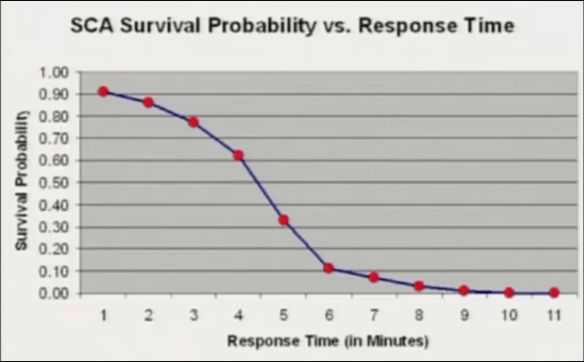
One presentation shown was from Les Bunte, former Assistant Fire Chief in Austin, Texas which covered the impact of delays in response times to medical emergencies – specifically to cardiac arrests. The delays to emergency service vehicles are a major concern to those opposed to increases in traffic congestion caused road space removal. He presented this chart:

SCA Survival

In England there is a target ambulance response time to Category 1 emergencies such as heart attacks of an average of 7 minutes which the country consistently fails to meet, and there are of course many responses that take longer than 7 minutes. In London the times are undoubtedly worse although I could not find any recent data on that subject as the London Ambulance Service does not report against the national target. All they report is that for Category A emergencies, 95% of ambulances arrive within 19 minutes. But you can see from the above chart that any response time of more than 10 minutes means you are almost certain to die.

Another presentation shown at the LA Conference was from the Portland Fire Department. According to the National Fire Protection Agency in the USA, in 2016 there were 35,200,000 emergency calls to fire departments around the country. Almost 22 million of these were fire and medical emergencies. Delays can have fatal consequences.

Delay to emergency response also means firefighters arrive at the scenes of emergencies in more dangerous conditions. In 2017, almost 59 thousand firefighters incurred injuries, and 60 firefighters died – most of which occurred at fireground operations. A number of fire fighters have also been injured from hitting the roofs of their cabs, rushing to emergencies when encountering speed humps.  At least two of these firefighters have been placed on permanent disability

The chart below compares the number of vehicle related deaths – pedestrians, cyclists and vehicle passengers (2018 stats) with the average yearly deaths caused by sudden cardiac arrest (SCA – not considering victims of other medical emergencies) plus fires in the USA. SCA and fires are Class A emergencies, requiring the most urgent emergency response times.

The data shows that a person is nearly 10 times more likely to die from fire and cardiac arrest than ALL vehicle-related accidents involving pedestrians, cyclists and passengers of cars. Clearly it is very important to maintain fast response times to medical emergencies.

USA Fatalities

This is quite conclusive evidence of the negative impacts of delays to emergency vehicles caused by road narrowing, speed humps and other traffic calming measures that increase traffic congestion and slow emergency services.

Roger Lawson

Twitter: https://twitter.com/Drivers_London

You can “follow” this blog by clicking on the bottom right.

Press Release: How Do Politicians Create Taxable Air Pollution Scares?

Hardly a day goes by without a new study claiming to ‘link’ particulate matter (PM2.5) in outdoor air to deaths or diseases, even from short term exposure.

In short, the answer is ‘Epidemiology,’ which is the study of the distribution and determinants of diseases in populations. It works well when a disease has a single cause like a virus, for example, but it is unable to reliably attribute a single cause to a disease that has multiple potential causes. Air pollution studies do NOT measure the actual exposure of individuals to outside or indoor air. Indeed some studies do not even measure the level of air pollution, they model it instead. Epidemiology relies on statistics in order to try and correlate cause with effect, but one of the principle caveats of science is that ‘correlation isn’t necessarily causation.’ Indeed, margarine consumption in Maine produces a 99% correlation with divorce, but no one believes that margarine is linked to divorce (1).

The ignored ‘elephant in the room’ is the fact that a smoker inhales 10,000 to 40,000 microgrammes per cubic metre of PM2.5 from a single cigarette (2) in a few minutes, which is the equivalent to the PM2.5 inhaled over 50 to 200 days by a non-smoker from outdoor air. (A microgramme is a millionth of a gramme). Smoking cessation studies show that a pack-a-day smoker who gives up after 20 years will have the same 80-year life expectancy as a non-smoker and the same risk of cardiovascular disease at the age of 55 (3), despite inhaling 2kg of PM2.5 over the 20-year period compared to 60g for the 80-year lifetime of a non-smoker.  This challenges the claims of deaths from short-term exposure to PM2.5 as well as permanent damage.

The motorised transport-dependent economy is in danger of being further over-regulated and punitively taxed on the basis of soundbite headlines in the media, derived from epidemiological studies, that do not stand up to proper scientific scrutiny. Politicians are only too happy to parrot pseudo-scientific soundbites as justification for CAZ and ULEZ schemes, which massively fail any genuine cost-benefit analysis, taking tens of millions of pounds out of local economies for little or no health benefits in return. Let’s be clear; there is absolutely no scientific evidence linking levels of PM2.5 in outdoor air with deaths or diseases in the UK.

600,000 people die in the UK each year from all causes, which are defined on death certificates and coroners reports. No one dies from air pollution. Since 1970, emissions of PM2.5 have fallen by 79% and Nitrogen dioxide by 72% (4).

A very large peer reviewed study (2017) on California air quality and acute deaths 2000 to 2012 found no association of acute deaths with levels of PM2.5 or ozone (5).

A 2019 peer reviewed paper exposes the bias and flaws in p-values and meta-analysis in papers linking short-term air pollution exposure to heart attacks (6).

25 peer reviewed publications 1995 to 2018 show no association between PM2.5 and mortality (7).

According to the British Heart Foundation, since 1961 the UK death rate from heart and circulatory disease has declined by more than 75%. Death rates have fallen more quickly than the actual number of deaths due to increased life expectancy.

The Committee on the Medical Effects of Air Pollution (COMEAP, 2018) could not unanimously link NO2 to mortality (8).

<ENDS>

Notes for Editors

(1) Spurious correlations: Margarine linked to divorce?https://www.bbc.co.uk/news/magazine-27537142

(2) National Research Council. Environmental tobacco smoke: measuring exposures and assessing health effects. Washington, D.C.: National Academy Press; 1986.

(3) New smoking cessation study (2018) debunks EPA’s PM2.5 death claims:

https://junkscience.com/2018/11/new-smoking-cessation-study-debunks-epas-pm2-5-death-claims/#more-94964

(4) Emissions of air pollutants in the UK, 1970 to 2017:

https://www.gov.uk/government/statistics/emissions-of-air-pollutants

(5) Air quality and acute deaths in California, 2000 – 2012:

https://www.sciencedirect.com/science/article/abs/pii/S0273230017301538

(6) Evaluation of meta-analysis of air quality and heart attacks, a case study (2019):

https://www.tandfonline.com/doi/full/10.1080/10408444.2019.1576587

(7) Negative studies on PM2.5 and mortality:

https://junkscience.com/2018/06/negative-studies-and-pm2-5/

(8) COMEAP (2018):

https://www.gov.uk/government/publications/nitrogen-dioxide-effects-on-mortality/associations-of-long-term-average-concentrations-of-nitrogen-dioxide-with-mortality-2018-comeap-summary

London Councils Making Even More Money From Parking

The RAC Foundation have published some figures on how much local Councils profit from parking. The latest data shows that the profits they make have risen by 7% to £930 million in the last year. The profits in some London boroughs are the highest in the country with Westminster, Kensington & Chelsea, Wandsworth, Hammersmith & Fulham, Camden and Islington all being in the top 7. In fact 12 of the 13 highest profiteers in the country are all in London with only Brighton & Hove being the exception.

Total income received from parking was £1.75 billion with costs incurred were £0.82 billion. Income comes from on-street parking, permit parking schemes, off-street car parks owned or run by Councils and parking enforcement. They are not supposed to make a profit from on-street parking but clearly do in many cases. However they can legally charge what they like for off-street car parks.

Any surplus from on-street parking is supposed to be spent on transport improvements but that is in practice a very broad item and includes expenditure such as supporting concessionary public transport fares, cycle lanes and many other things that have no benefit whatsoever to vehicle users who have paid for the parking. In reality Councils are using parking fees as a slush fund to finance all kinds of projects in some boroughs. Some of the surplus is spent on road maintenance but that has been falling which is why there are more and more potholes on our roads.

It is surely time for national government to intervene to rectify these abuses that are taking place because high parking charges are destroying many High Streets and Town Centres as retailers are already under pressure from the internet.

For more information and to see how your local borough compares the RAC Foundation report is present here: https://tinyurl.com/qm9ypy2

Twitter: https://twitter.com/Drivers_London

You can “follow” this blog by clicking on the bottom right.

Westminster Proposes 20 MPH Limit Everywhere

The City of Westminster is proposing to implement a 20 MPH speed limit on all its roads. The only exception will be those roads they do not control which are TfL controlled roads and where TfL may impose such a limit anyway. This move is despite the fact that a report published by the Department of Transport shows there is no road safety benefit in signed-only 20 MPH limits and there is also no evidence of any other benefits.

Readers should oppose this move, which is in essence a waste of money that would be better spent on other measures, by responding to the public consultation here: https://www.westminster.gov.uk/20mph

Twitter: https://twitter.com/Drivers_London

You can “follow” this blog by clicking on the bottom right.


Pelican Crossing at the War Memorial Junction in Chislehurst – Council Decision

As mentioned in a previous blog post (see https://tinyurl.com/y56v2rty ) a petition signed by over 3000 people was submitted to Bromley Council for a Pelican crossing to be installed on the War Memorial Junction in Chislehurst. The previous blog post gives a full analysis of why it was not necessarily a good idea.

Tonight the full Council met to consider the petition. Chris Wells who promoted the petition was allowed to speak for 5 minutes but clearly did not convince Councillors to change their minds. He reiterated his past arguments on the need for a pedestrian crossing phase. A resolution was passed by a very large majority of Councillors to let the previous response from the Council stand. In addition a motion from Councillor Dunn to require the Environment Portfolio holder to submit a proposal within 6 months was also defeated.

Councillor Huntington-Thresher who holds that position explained that the junction had been the subject of several studies but most were unable to be progressed due to the restrictions on land usage imposed by the Chislehurst Commons Trustees. However, they will continue to look at the junction but no immediate change is proposed.

He stated they had modelled traffic flows at the junction (which Chris Wells claimed had not been done) and if a pedestrian phase was added the traffic queues could triple in length. [Comment: that would certainly be a major annoyance to many people as they could stretch for much more than a mile and would also generate a lot of “rat-running” down side roads which was a concern for road safety]. Councillor Huntington-Thresher said we need a “holistic” solution.

He also stated that despite the claims of road safety danger, the relevant section of the A222 was actually only the 40th most dangerous in the borough. There was no trend in accidents and there were no injury accidents in 2018. In other words, resources might be better spent elsewhere to improve road safety. He also said it was not necessarily possible to submit a proposal within 6 months so opposed Mr Dunn’s motion.

Councillor Katy Boughey who represents the Chislehurst Ward spoke in support of the aforementioned response and said that they were actively working with all relevant parties to find a solution. Council Leader Colin Smith seconded the motion to make no change to the previous response and referred to regrettable “excitable hysteria” on Twitter on the subject.

The above is a brief summary of the meeting to debate on this subject. Let us hope that those who support Mr Wells actually listen to reason and engage with councillors, council staff and other local stakeholders to develop a good solution to improve this junction. Any solution needs to take into account road safety issues, traffic congestion problems and the interests of both pedestrians and road users. Any criticism of councillors or council staff would be misguided. You don’t solve road safety and traffic management issues by emotive hysteria.

I hope the above is a reasonably accurate note of what happened but anyone else who was there can correct me or add further comments if required.

Roger Lawson

Twitter: https://twitter.com/Drivers_London

You can “follow” this blog by clicking on the bottom right.