Lewisham Neighbourhood Meeting – Councillors Ignore Public Opposition.

Lewisham Meeting 2020-02-12

Last night (11/2/2020) there was a “Lee Green Assembly” meeting at which the main topic was the proposed Healthy Neighbourhoods scheme. It was well attended with I would guess over 100 local residents there. I tried to ask some questions but was ignored; however my points were well covered by other people.

The event was managed to avoid debate – for example by dealing with questions in threes which avoids follow-up responses. It was clear that some people supported the scheme but it was also obvious that more people opposed the scheme than supported it. Councillors present simply brushed off the objections. One speaker suggested it was appropriate that the event was held in a school because they were being treated as schoolchildren.

I will cover some of the speeches and the questions/answers in detail but this is not a verbatim report:

  1. Councillor James Rathbone (for contact info see below) opened the meeting but Councillor Octavia Holland then spoke. She said the key objective was to reduce traffic. The drivers of the policy are air quality and pedestrian safety. She apologised for people not hearing about the proposals. She mentioned there had been more than one petition on the subject (Note: one of these is still open – see https://tinyurl.com/wpbx57u – you may care to sign it). She also said that 60% of traffic in the area is not starting or stopping within it and admitted that the scheme was going to be inconvenient for some people – that is particularly so as 65% of households in the area own a car. It will need significant change in how people organise their lives.
  1. The scheme is based on the Mayor of London’s Transport Strategy and there will be a consultation during the trial period. The scheme also depends on approval by Transport for London (TfL) as it might impact on bus journey times. There will also be multiple “drop-in” sessions, and it was said later that will be another “letter drop” (Comments: so why can’t they simply ask residents whether they support the proposal or not?).
  1. It is also proposed to extend the current CPZs across the area and there will be a public consultation on those proposals.
  1. Questions were then taken by Octavia and Josh Learner who is the Cycling and Walking Programme Manager at Lewisham Council.
  1. The first Question/Comment was from a police constable who said the modal filters will impact emergency response times. It will apparently require the police to get out to unlock and remove the “bollard” to gain access and replace afterwards. She said that you would be “buggered” if it was a single person call-out. The response was that it works OK in other similar schemes.
  1. Another issue raised was the increased traffic on Hall Park Lane coming off the A205 to avoid the road closures. Answer: This is being discussed with Greenwich Council who are responsible for that area – more closures might be imposed.
  1. A cyclist who lives on Burnt Ash Hill supported the scheme but raised the issue of monitoring of air pollution before and after the trial (there may be more traffic on that road, increasing air pollution). The answer was that it will be monitored.
  1. The next speaker who lives on Manor Lane near the blockages was concerned about increased traffic and difficulty getting onto the South Circular which is already a problem. Answer: this will be looked at.
  1. The next speaker complained about the consultation. Why not a simple vote on the scheme, with a letter sent to everyone? (Comment: this is a very good point).  The answer from a councillor was simply waffle at which point they were shouted down. But it was said that the scheme would not be stopped regardless of the public views [in other words, the “consultation” is a farce as the public will be ignored anyway).
  1. A resident of Burnt Ash Hill said that they were going to be poisoned but you are ignoring us, and why can’t we have proper consultation. Councillor Rathbone said that Councils often went ahead without consultation and mentioned a similar scheme in the London Borough of Bromley at Shortlands (Note: the Shortlands scheme is very different and does not involve road closures. There is no public opposition and Bromley Council is very good at doing wide public consultations when necessary).
  1. The next speaker spelled out the impact of low traffic speeds on air pollution and mentioned the negative impact of a scheme in Walthamstow. The answer given was that it will be monitored in the trial.
  1. Another person raised the possible conflict of interest of having a TfL employee on the board of Sustrans who were developing the scheme.
  1. Another speaker raised concerns about the delay to emergency services and access to the South Circular. The answer was that the emergency services had been contacted but had no objections.
  1. One speaker suggested “timed” closures instead of 24-hour coverage to stop rat running during commuting hours. Answer: it could not be done as part of the trial.
  1. A speaker asked whether there were targets for reduction of air pollution and traffic. Answer: There was none because the final design was not settled and there were “too many moving parts”. Comment: this is a major omission and makes it clear that with no targets being set the “trial” will be considered a success regardless of the facts.
  1. The next question was “had they consulted local businesses”? For example Brewers on Chiltonian Estate? Answer: businesses had been overlooked and they are looking into that. Note: we sent a few letters to such businesses but we could not cover all of them and they will be very badly affected.
  1. A resident of Dallinger Road queried the closures and asked how vehicles were expected to turn around when they ran into one. Answer was that perhaps we should move the closures to the other end of those roads. Comment: I don’t see how that solves the problem.
  1. The next speaker complained about the problem of quick access to Lewisham Hospital as all the fast routes would be cut off (the speaker’s husband had often had to be taken to A&E). Answer: there will be some people who take longer to get to hospital. (Comment: delays to emergency services are already a major problem in London where they consistently fail to meet response time targets. Don’t have a heart attack in London as you are likely to die as a result! The road closures in Lewisham will make matters worse).

It was mentioned in the meeting that another draft of the scheme will be proposed. The last one published was Version 11 so there will be a Version 12, or 13, 14, etc as someone suggested.

It was very clear from the comments of people at the meeting that there is widespread opposition to the scheme as proposed, particularly against the road closures. These might make air pollution slightly better for some, but a lot worse for others. Journey times will be substantially increased.

But councillors and council staff seem to want to push ahead regardless. Anyone who has had dealings with councils will know that they hate to admit mistakes and reconsider proposals or abandon them despite public opposition. That is what is happening in Lewisham.

It is also clear that Lewisham Council is pushing ahead with a “trial” of the road closures before doing a proper public consultation. This is an “arse about face” approach to put it politely. They will never to be taken out later.

I urge all residents of the Lee Green area to contact their councillors below.

Contact information:

Councillors:

James Rathbone: http://councilmeetings.lewisham.gov.uk/mgUserInfo.aspx?UID=2990

Octavia Holland: http://councilmeetings.lewisham.gov.uk/mgUserInfo.aspx?UID=2989

Jim Mallory: http://councilmeetings.lewisham.gov.uk/mgUserInfo.aspx?UID=167

Roger Lawson

Twitter: https://twitter.com/Drivers_London

You can follow this blog by entering your email address below.

Book Review – Demotorized – A Witty Look at the Use and Taxation of Motor Cars 

Demotorized Cover

“Demotorized” is a new book by experienced motoring journalist James Ruppert. As he describes it himself, it “is partly a giant whinge on behalf of the average motorist” whereas he believes motor cars are a “force for good that outweighs any downsides”. That is certainly what we believe.

The book is a witty look at the history of the automobile and how politicians have taxed them, often using excuses for doing so that have created unintended consequences. Or they have simply misunderstood the technology and the underlying science so that money has been wasted and negative results obtained – such as the push for diesel usage that has now been reversed.

The author takes a close look at the global warming paranoia that is being used to attack personal vehicle use – he clearly does not believe in it at all. He also takes a look at the revenue raising from the pursuit of speeding offences, but unfortunately fails to mention the false statistics on which it was based and how money is being generated by “speed awareness” courses. Indeed he suggests that the latter is a “local authority revenue raiser” when in fact few local authorities currently run such courses – It’s mainly commercial organisations and it’s them and the police who are the main financial beneficiaries. At least that is the current position although there are moves to enable local authorities to get on this gravy train.

There is a good section on the history and future prospects for electric vehicles. The author makes it plain that their economics have yet to be proven.

It’s quite a long book at over 300 pages and a mine of useful information so at £9.99 for the paperback edition it’s good value. But it’s still an easy and amusing read – indeed sometimes it’s difficult to tell whether the author is being serious or not.

In summary a useful book for anyone who wishes to learn more about the motor industry and how the motorist has suffered from perverse government policies.

Twitter: https://twitter.com/Drivers_London

You can “follow” this blog by clicking on the bottom right.

Safer Speeds – The Real Data

I have commented before on how Transport for London (TfL) have failed to justify their “Safer Speeds” proposals which includes imposing 20 mph speed limits on many roads. We have previously pointed out how TfL have been misinterpreting police accident data to support their claims that the measures are justified.

For example, they issued a Tweet that said “speed accounts for 37% of all death and serious injuries” in road accidents in London. That figure is simply wrong. The claim was allegedly based on the STATS19 data reported by the police (a form they fill out about every accident involving injuries).  That form allows for multiple factors to be recorded and after submitting a Freedom of Information Act request we learned that they counted all the accidents where factors 306, 307 and 602 were noted.

But factor 602 is described as “Driver/rider either behaved in a negligent or thoughtless manner or was in a hurry….”. Clearly the key word in that sentence is the second “or” when TfL have interpreted it to mean “and”.  There is no basis for claiming that all accidents where factor 602 is attached were rated by the police as ones where a driver was in a hurry. They might have simply been careless. Only where the other factors 306 or 307 were also noted could there be any claim that speed was a factor in the accident.

We now have the complete accident data and the data makes it plain that exceeding the speed limit (factor 306) is a very minor factor in KSIs (Killed and Serious Injuries) in London. It’s actually recorded as a contributory factor in only 5.9% of such accidents in the last five years. That’s actually less than the figure of 7.1% reported by the Department for Transport for the national figures in 2018 – see table below. Clearly tougher enforcement of speed limits is therefore unlikely to have much impact on the overall numbers. That of course is particularly so in London where average traffic speed is typically well below the speed limit.

Contributory Factors and Speed - ras50008

The largest contributory factor by far is “Failed to Look Properly” which accounted for 42% of KSIs in London or 35% nationally. But there are several other factors with higher ratings than “Exceeding the Speed Limit” such as “Poor Turn or Manoeuvre”, “Failed to Judge Other Persons Path…”, “Loss of Control” and “Careless, Reckless or in a Hurry”.

Even if you bundle factors 306 and 307 together only 12% of KSI incidents are included nationally so reducing speed limits is going to have only a small contribution at best to reducing such accidents. It’s reducing the other factors that is the key to substantially reducing road casualties. More driver education, improved roads and research into saccadic masking may be productive.

Note also that a lot of the reported factor 306 and 307 claims of excessive speed and speed above the speed limit might well involve illegal use of vehicles such as stolen vehicles so reducing speed limits will have negligible impact in reality.

There is simply no cost/benefit justification for the Safer Speeds proposals as pointed out in our previous article and TfL have clearly been abusing the data so as to make spurious claims.

Roger Lawson

Twitter: https://twitter.com/Drivers_London

You can “follow” this blog by clicking on the bottom right.

TfL Business Plan and Budget for the Next 5 Years – More of the Same

London Road

Transport for London (TfL) have published their Business Plan to cover the next 5 years and a Budget for the next year. The latter has already been approved by the London Assembly.

I shall pick out a few key points from these long documents which are certainly worth reading if you have the time – see https://tfl.gov.uk/corporate/publications-and-reports/business-plan .  Bear in mind that as always, it’s money that drives the political and policy decisions – in this case the apparent desire of the Mayor to build a bigger empire and control more of our lives. So private transport will be discouraged and he wants more money from central Government and from Londoners to fix his self-inflicted budget problems caused by fare freezes, Crossrail delays and reckless expenditure on cycle infrastructure.

The delays to Crossrail and its rising cost run through the whole document like an albatross around the Mayor’s neck. Crossrail is now unlikely to open until 2021 which means £750 million in lost revenue as against that expected, hitting the TfL budget. In addition the delays and extra work means extra costs of up to £650 million and it’s not clear where that money will be coming from. There are very optimistic forecasts in the Business Plan for income from Crossrail – for example £884 million in 2023/24. Will it really be achieved?

Diesel Buses, one of the major sources of air pollution in the capital, are to be replaced to a large extent by 2,000 zero-emission buses by the end of the 5-year business plan period, but the whole fleet will not be zero-emission until 2037. However they will be at least Euro VI compliant soon. There is also a commitment to install 300 rapid Electric Chargers for other vehicles by the end of 2020.

Note that the London bus network has been reduced partly due to falling passenger numbers and income no doubt but there is also a reduction in central London offset by increases in outer London.

TfL Transport Commissioner Mike Brown reiterates the commitment to Vision Zero to reduce road casualties despite the fact that the policy has had negligible impact to date – see a previous blog post on that subject. He also commits to tripling the amount of “protected” Cycling space which will mean more underused cycle lanes. But he is also committing to make 73 junctions safer which may assist cyclists.

Despite cutting operating costs, one of the few good things reported, there will be deficits of £307m, £493m and £513m in TfL (after “capital renewals”) for this year and the two following ones and barely break-even in 2022/23. As a result the Mayor will have to substantially increase borrowing to cover that and large amounts of capital expenditure for both Crossrail and other network improvements. That includes £2.2 billion this year and next year, followed by £1.2 billion each year in subsequent years. Total borrowing will reach £12.3 billion within 2 years. None of this is being spent on the road network of course other than some maintenance.

So far as the road network is concerned, the maintenance of road surfaces including the repair of pot-holes has been reduced in the last two years which the documents concede has caused a deterioration in road assets. However there is a commitment to “gradually restore the condition of highway assets, with a focus on those that contribute more to walking, cycling and public transport” whatever that means. Does that mean they will fund repairs to bus lanes but not the rest of the road?

On Hammersmith Bridge whose closure is causing major problems in West London, the document only says that £25 million has been allocated to pay for preliminary work but no contract will be awarded to repair the bridge until Spring 2020 and it might take several years to complete the work. It is unclear where the money required will come from. The Rotherhithe Tunnel will be refurbished within the next 5 years – cost of around £140 million, and work done on the A40 Westway. Work on the Silvertown Tunnel should commence in 2020 and complete by 2025.

As regards the ULEZ, the Budget document finally discloses some financial figures. In 2018/19, the ULEZ will contribute most of the £215 million improvement in operating income in the current year, but with implementation costs of £58 million, i.e. a net £157 million which is somewhat more than previously forecast (see   https://tinyurl.com/y4w6pwuk ). As the Budget document only covers the year 2019/20 and no details are provide in the Business Plan the impact of the extension of the ULEZ to the North/South Circular is not apparent but the Mayor clearly intends to push ahead with that (assuming he gets re-elected).

The Business Plan indicates that fares income is expected to rise at around RPI which ignores the fact that Sadiq Khan has already promised to continue to freeze public transport fares if he gets re-elected, at least for 2020. So the Business Plan may be totally unrealistic.

In summary the Business Plan and Budget demonstrate an incompetent Mayor and senior management at TfL who wish to get us all cycling, walking or using public transport while the road network gets worse. This results in more traffic congestion and more air pollution which most Londoners would prefer them to fix. The persistent financial mismanagement by the Mayor will also come home to roost sooner or later.

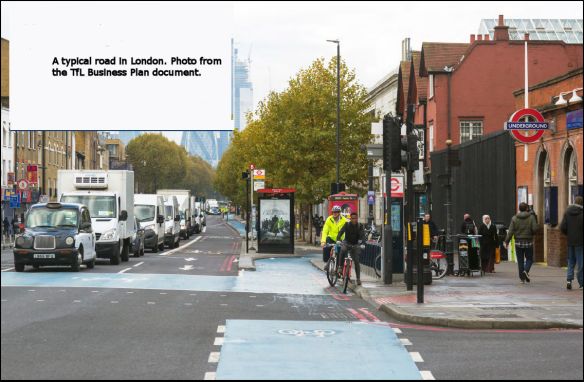
A good example of the result of his policies is actually shown in a photograph of an east London street in the Business Plan document. A long queue of traffic in one lane with the bus lane unused and few cyclists in the cycle lane! See above.

Roger Lawson

Twitter: https://twitter.com/Drivers_London

You can “follow” this blog by clicking on the bottom right.

Reporting a Road Incident to the Met

The Metropolitan Police have had a useful web site for reporting a crime or road accident for some time – see https://www.met.police.uk/ , where is not an emergency. It’s very easy to use and saves you having to visit a police station. They also now seem to have added a specific page to enable you to report a road incident and upload some dashcam footage – see:  https://www.met.police.uk/dashcam

But one person said on Twitter: “Can someone explain why I can film freely with a dashcam but to put a CCTV camera in a public space I have to jump through various legal hoops under the Surveillance Camera Code of Practice issued “to ensure that the use of cameras is only used in pursuit of a specified purpose”.

That’s a good question. A quick review tells me that this is a complex area of regulations. The use of video cameras is governed by two bodies – the Information Commissioner (ICO) who lays down guidelines, and the Surveillance Commissioner who regulates Police Forces and Local Authorities but their guidance is only advisory for other organisations so far as I can see.

But the ICO barely seems to be keeping up with technology. For example they say “The ICO recommends that users of drones with cameras should operate them in a responsible way to respect the privacy of others” and not much more.

In essence I conclude that a dashboard camera (dashcam) is no different to using any other kind of camera in a public place and hence is not subject to regulation except that any photographs that may contain personal information need to be stored securely and other data protection rules apply.

But a fixed video camera that covers a public place (e.g. a street outside your house) is subject to guidelines issued by the ICO and unless there is a justifiable purpose a complaint against it might be upheld.

There is clearly a general privacy issue here. Dashcams are obviously very useful if an accident has occurred or a potential crime. That has to be counterbalanced against the pervasive surveillance of the population that now happens in all locations and at all times. In London this has reached astonishing proportions. One estimate is that there are 500,000 video cameras in London and the Police have access to the Congestion Charge and ULEZ cameras and others that will soon cover most of London. That’s in addition to all the commercial and domestic cameras. In essence privacy has disappeared if you live in London!

Roger Lawson

Twitter: https://twitter.com/Drivers_London

You can “follow” this blog by clicking on the bottom right.

Leon Daniels Promotion of Cycling, and Vision Zero Failing

OnLondon have published a very interesting talk by Leon Daniels  – see link below. He was the former Managing Director of Surface Transport for TfL and “acted extraordinarily quickly” to implement the Cycle Superhighways. Indeed he suggests that he might have barged them through without properly considering the views of all interested parties and assessing the outcomes properly.

The reason he gives for their implementation was to cut the number of cyclist deaths on London’s roads and to tackle the air quality issue by encouraging more cycling. But he concedes that the cycling infrastructure has had a negative effect on bus speeds and “indeed for all traffic”.

His solution to end the war between different kinds of road users is a “self-healing” city although it’s not totally clear what he means by that.

Comment: Cycle superhighways and other cycling infrastructure have not cut cycling deaths and cycling is still very much the interest of a small minority so the reallocation of road space to them has had negligible impact on traffic. Indeed it has caused more traffic congestion and hence more air pollution. It was clearly a poorly thought through policy with unintended consequences.

You can read Mr Daniel’s talk here:

https://www.onlondon.co.uk/leon-daniels-london-cycling-and-the-self-healing-city/

Vision Zero is one of the policies being pursued by TfL to reduce road casualties. It promotes traffic speed reduction among other things. We have commented previously on how ineffective it has proved to be – see https://freedomfordrivers.blog/2019/07/29/mayors-vision-zero-strategy-failing/

Now there is similar evidence from the USA. Vision Zero is aimed at reducing deaths and serious injuries to zero, but in major US cities who have adopted the strategy they are far from achieving their target. In fact cyclist and pedestrian casualties in the USA have been increasing and the figures for individual cities show there are very mixed result. See https://www.citylab.com/newsletter-editions/2019/11/citylab-daily/602455/ and here  https://www.motorists.org/blog/do-vision-zero-programs-equal-more-traffic-accidents/ for details.

Vision Zero was a policy invented in Sweden in 1997. To quote from an OECD report on accident figures in Sweden: “The longer-term trend for road deaths in Sweden has been downwards trending. Between 2000 and 2018, the number of annual road fatalities fell by 45%. However, the trend in the decline of traffic fatalities has stagnated since 2010. The road fatalities total for 2018 is actually a 21.8% increase on 2010’s total”. It would seem that the policy is failing in Sweden also now.

Comment: Vision Zero is probably failing because it is like all simplistic road safety policies pursued by well-meaning but ignorant politicians. Having an objective which is widely publicised without a clear view on what measures will actually achieve it in the long-term is not helpful. Vision Zero seems to be diverting road safety resources from what is known to work to policies that don’t.

Roger Lawson

Twitter: https://twitter.com/Drivers_London

You can “follow” this blog by clicking on the bottom right.


Greenwich to Woolwich Road Degradation

Transport for London (TfL) have announced proposals for changes to the A206 between Greenwich and Woolwich that will lead to slower traffic, cause more traffic congestion and raise air pollution. The A206 is the main road between Woolwich and Greenwich. The proposals, which are open to public consultation include these proposals:

  • A new two-way Cycleway which will take up some of the existing road space and run along the south side of the road and remove one of two traffic lanes.
  • Six new pedestrian crossings.
  • Extending the existing bus lanes and new ones to effectively turn a two-lane road into one for all other traffic effective from 7.00 in the morning to 19.00 in the evening (7 to 7).
  • Widening the footway at a number of locations.
  • Closure of Charlton Lane.
  • Speed tables to slow traffic on the A206.
  • Changing the Angerstein Roundabout (the one under the A102 Blackwall Tunnel Approach) to improve safety – see photo below. That includes removing the central “roundabout” and banning turns onto the A102 so as “to reduce traffic volumes”. There have been two fatal accidents there in the last two years.

The ABD’s comments which we have submitted to the consultation are:

  1. There are certainly some parts of this road that could be improved for pedestrians and cyclists and the addition of a few pedestrian crossings may be justified. However, pedestrian crossings should be justified based on the number of pedestrians crossing the road at the given point, the difficulty of doing so and the volume of traffic.
  2. The Angerstein Roundabout is certainly a poor design at present as it is even difficult for vehicles to navigate if the driver is unfamiliar with the layout and HGVs are involved. Changing it to remove the roundabout and simply making it a signalised junction does make sense. However we object to the removal of turns onto the A102 as it is not clear what the alternative routes might be for larger vehicles and it might encourage the use of narrow side streets by other vehicles.
  3. We object to the use of speed tables, or any other form of speed humps, particularly on major roads such as the A206 and those used by buses. They generate severe discomfort for vehicle users and for bus passengers.
  4. We doubt the claim that these changes will not cause significant traffic delays, and particularly object to the prioritisation of the needs of cyclists (who only make up 5% of the road users according to TfL) over other road users.

You can read more details of the proposals and respond to an on-line consultation from this web page: https://consultations.tfl.gov.uk/cycling/greenwich-to-woolwich/

Make sure you object!

Note as usual with TfL consultations no information on the cost of the proposals is provided, nor any cost/benefit analysis. Please complain about that also.

Twitter: https://twitter.com/Drivers_London

You can “follow” this blog by clicking on the bottom right

Travel in London Survey – How It’s Being Made More Difficult

Transport for London (TfL) have released their latest survey of travel patterns in London.  It’s a mine of statistics but the “spin” put on the data is generally grossly misleading. For example, it says “Londoners and visitors make increasingly sustainable choices for how they get around, choosing to walk, cycle and use public transport”.  Walking and cycling have slightly increased – see comments below, but how is public transport “sustainable”? A high proportion of public transport is buses and diesel London buses are a major contributor to air pollution while air pollution on the London Underground is worse than on London’s streets so how is that “sustainable”? Of course there is no definition of “sustainable transport” in the Report  – it’s simply a way for TfL to claim some things as good and others bad.

Total travel demand in terms of number of trips taken has been flat for the last three years despite the continuing growth in the population. In reality Londoners are choosing to travel less simply because traveling in London has become more difficult. Public transport has become overcrowded while private transport (cars and PHVs) are being discouraged in numerous ways.

Bus journeys declined by 1.8% last year probably due to the same reasons as the decline in use of cars – traffic congestion has slowed journey times, making it quicker to walk in many cases.

Cycling in terms of cycled kilometres rose by 5% it is claimed but still only accounts for 2.5% of all trips despite the massive expenditure on cycle superhighways and other cycling facilities. This figure is also distorted by using distance cycled instead of number of trips by that mode. You can see the data more clearly by looking at this chart from the Report:

Per Person Trip Rate

This shows clearly that cycling has not been growing and any alleged increase is simply down to the growth in the population of London. This is what one person had to say on Twitter: “The same tiny number of people cycled 5% further because the weather was a bit nicer than usual that year; at a cost of £millions to taxpayers, while record numbers of Londoners sleep rough and get murdered. In any other setting this would be surreal: but not in Sadiq Khan’s London”.

The Report also claims success in the Mayor’s objective of promoting more “active travel” such as cycling and walking to make us more healthy. As regards walking the above chart shows how walking has declined over the last ten years. And Figure 5.2 in the Report shows that the percentage of people achieving 20 minutes per day of active travel is basically unchanged in the last ten years.

The big trends over the last ten years have been increases in underground patronage – up 25.6% – and national rail usage – up 41.5%. Which explains why you cannot get a seat on the trains or the underground and during rush hours you’ll either be squeezed into the carriages or can’t even get into the station. This has arisen because of a failure to match public transport provision with the growth in London’s population which incidentally is mainly from immigration as the Report spells out.

Bus journeys declined by 1.7% last year and have actually declined by 0.6% over the last ten years. It seems that nobody likes buses. Perhaps it’s that standing in the cold or rain waiting for a bus or unreliable bus arrival and trip times that puts them off – it certainly does this writer.

Motorised road travel declined slightly in inner and central London but rose slightly in outer London. Londoners are apparently reluctant to give up car use despite the ever increasing restrictions on them. One change though is the use of PHVs (mini-cabs) has risen to offset the decline in private cars. For example it is estimated that as much as 40% of car traffic in central London at certain times is accounted for by PHVs, but their numbers are forecast to fall substantially due to removal of the exemption from the Congestion Charge (a.k.a. Tax) and the new ULEZ tax.

The Report notes how serious road traffic casualties increased last year which shows how the Mayor’s “Vision Zero” strategy is failing. But interestingly it also notes that injuries in the London Underground increased by 6% last year to 3,968 while bus passenger injuries declined by 8.6% to 4,889. These are surprisingly high numbers but still less than those injured in road traffic accidents.

Only 56% of London households have access to a car with an even lower proportion in inner London. But this proportion has not substantially changed in the last ten years (see Figure 4.12 in the Report).

The report gives some data on air pollution and in particular of NO2 emissions which mainly come from transport. This has been falling substantially, particularly in central London, mainly due to changes to newer vehicles in the vehicle fleet. See chart below taken from the Report.

NO2 Trends

The Report goes on to claim an impact from April 2019 from the introduction of the ULEZ in central London but in reality the trends in the above chart will simply have continued so any claim for an impact from the ULEZ is a figment of TfL’s imagination. It is simply too early to claim any impact as reliable data is not yet available. And just to remind you, there is no clear medical evidence of any negative impact of NO2 on human health.

In summary although this TfL Report contains some useful data, it misinterprets the trends in London travel patterns and the impact of the Mayor’s Transport Strategy. Most of the changes in travel trends in London have probably occurred from a rising and ageing population.

The report is very selective in both data reporting and interpretation. For example there is no data on traffic congestion which from most users experience has worsened considerably in recent years. That degradation has taken place from policies pursued by TfL which has meant removal of road space from cycle lane installation, widening of pavements, junction changes, more pedestrian crossings and traffic lights and other negative changes.

However an interesting section of the Report is on future travel demand and possible “Scenarios” in Chapter 14. One of the three scenarios is “Accelerating London” with high levels of population growth and immigration, high housing costs and rising crime rates, i.e. more of the same. A second scenario is a “Rebalanced London” with lower economic growth, a stable population size with actual falls in inner London and a slower pace of life. It sounds positively utopian if you read it. The third scenario is “Innovating London” where there is a focus on more technology both in employment and facilitation of travel. It does not say which the Mayor of London might back however.

Regrettably as with anything the Mayor or TfL issue, the Report is more of a public relations document than an unbiased analysis of the trends in London travel and its causes.  It should be read with caution.

You can find the Report here:

http://content.tfl.gov.uk/travel-in-london-report-12.pdf

It just remains to wish readers of this blog Best Wishes for the New Year and a belated Happy Christmas

Roger Lawson

Twitter: https://twitter.com/Drivers_London

You can “follow” this blog by clicking on the bottom right.

Why Cost/Benefit Analysis Is So Important

The world is becoming full of irrationality. Political decisions seem to be driven more by emotion than by science of late and all we see on television news are human interest stories rather than facts and analysis.

This creates an atmosphere where those who shout loudest are listened to while quiet scientific analysis is dumped. Thus organisations such as Extinction Rebellion get lots of publicity and media personalities such as Greta Thunberg get massive coverage however wrong they are.

But emotions drive bad decisions.

Let’s consider the issue of road safety for example. Everyone recognises that there are still too many deaths and serious injuries on our roads, many or which might be avoided. But if we decide this is a major national priority on which money should be spent (i.e. from taxes), where do we spend it? A rational person would say “spend it on the most cost-effective proposals because that way we will save the most lives or injuries for a given amount of expenditure”. Bearing in mind there are limited financial resources in any Government, this has to be the best approach.

But there are various ways to reduce casualties, which includes:

  • Redesigning roads to make them safer, including tackling known blackspots.
  • Improved driver training and tougher tests for new drivers.
  • Improving in-car safety by better engineered vehicles.
  • Improving emergency medical treatment after an accident.
  • Cutting ambulance response times.
  • Reducing traffic speeds that might reduce casualty severity.
  • Exhortations to drivers to take more care with publicity campaigns.

You can probably think of some others that might help but the first four of the above have probably had the most impact in the last few years on casualty reduction. Where should the money be spent? What provides the best cost/benefit ratio is the answer.

At the lower level, if we decide that money spent on improving roads is worthwhile, then where do we spend it? The answer is again simple – on those locations where the money will save the most casualties. But many local councils ignore that approach and simply listen to local pressure groups.

Or at the higher level, should the Government spend money on road safety, on improving hospitals, or on improving home safety. For example about 1,700 people die in road accidents each year in the UK, but there are about 6,000 deaths each year from accidents in the home, and 40,000 deaths from cancer. The latter might be susceptible to more expenditure on treatment or research, while many home deaths are due to falls down stairs. Should the Government invest in lifts for all multi-storey homes or only allow bungalows to be built in future? Some 55% of injuries in the home are burns caused by cooking. Should the Government ban cooking?

You can see how this whole field is a minefield of conflicts of interest and instead of rational analysis people tend to spend money where they think it might help or based on traditional ideas. But the answer is to evaluate the cost versus the benefit on a simple uniform financial measure.

The benefit of saving a life, or a serious injury, can be valued and the Department for Transport regularly publishes their figures for those costs – currently it’s about £2 million for a fatality, £250,000 for a serious injury and £25,000 for a minor injury. One can dispute how it is calculated and how optimistic or pessimistic that figure is, but it does provide some basis for working out how much should be spent on saving a death. In addition there are many more minor accidents than KSIs (about 100 times the fatalities), and minor accidents are easier to value because you can simply add up the medical treatment costs, the lost employment time, the emergency services costs and then ask the victims how much they would have paid to avoid the injury. So the overall costs can be roughly estimated with some accuracy.

A similar calculation is made for many other purposes – for example, what is the benefit of treating a patient with a life saving drug versus its cost? Or how by how many years will their life be extended and how do you value an extension of life? Such calculations are a regular element in public policy decisions, although there are few hard guidelines on the subject at present.

The above indicates how the benefits might be calculated. To offset those one has to work out the costs. That includes in the case of revised road schemes, the construction cost of course, but there are often costs (or savings) imposed on road users. For example, in the recently discussed case of the Chislehurst War Memorial Traffic Lights (see https://tinyurl.com/y56v2rty ) where it was proposed to install a Pelican Crossing, the costs are not just the construction cost but the on-going costs imposed on the road users by the extra delays and traffic queues of having a pedestrian phase in the lights. In addition there are the negative costs of more accidents on minor roads due to traffic diversion to avoid the jams, and more air pollution from the stationary queues of traffic. These can all be estimated.

On the subject of air pollution, we currently have a lot of debate about the impact of that and what should be done to improve it. But there is typically little cost/benefit analysis. In reality, even if all air pollution was removed (an impossible task as a lot of it comes from natural sources), it might only extend the average population life by a few days. Meanwhile in London alone hundreds of millions of pounds of costs are being imposed on residents in the name of solving the problem. The cost/benefit on the ABD’s calculations for the London ULEZ scheme is extremely negative – see https://tinyurl.com/y4w6pwuk for the figures. Even Birmingham Council produced a negative figure when trying to justify their CAZ scheme but they still decided to go ahead.

This is public policy making turned on its head. The fact that both such schemes will generate large amounts of revenue for the Mayor of London and Birmingham Council was perhaps a more important part of their considerations! These “taxes” are an irrational imposition on the public and are not even an efficient way of collecting taxes.

Transport for London (TfL) have even given up on publishing any cost/benefit analyses of most new road schemes mainly because the figures when calculated show that they are simply uneconomic. Or they publish figures that are distorted by not including all the costs – for example on their “Safer Speed” plans.

Public life is being corrupted by the approach of relying on emotion to make decisions or by other motives rather than on a proper cost/benefit analysis. We need more politicians who are better educated and understand these issues, and the general public also needs to become better informed on these matters.

Roger Lawson

Twitter: https://twitter.com/Drivers_London

You can “follow” this blog by clicking on the bottom right.

Death from Mobility Scooter

An interesting news item that was lost in General Election dominance of the national media was that of the death of Frederick Longlands, aged 88. He was struck from behind by a mobility scooter which appeared to be doing more than the legal limit of 4 mph for such vehicles when riding on the pavement.

This happened in Ilkeston Derbyshire and the scooter driver would likely have been prosecuted but he also died soon after (he was aged 79). He was riding a “Class 3” mobility scooter which can be driven on the road and can legally do 8 mph there, but not on the pavement. Riders do not need a driving licence to ride on the road and the driver in this case had never held a driving licence.

The Coroner for the case is writing to the Government to ask for more protective legislation for pedestrians.

These kinds of accidents are likely to occur more frequently as the population ages and these vehicles become more common. It is a similar problem to the use of electric scooters (illegal on both public roads and pavements at present but the law is often ignored) and electric cycles. Both enable very high speeds and are very silent so pedestrians can easily be struck from behind with no warning, as in the above case. This whole area surely needs a review of the law.

Twitter: https://twitter.com/Drivers_London

You can “follow” this blog by clicking on the bottom right.