Lewisham Neighbourhood Scheme – Will Traffic Simply Evaporate?

I visited the Council’s “public drop-in event” for the Lewisham “Healthy Neighbourhoods” scheme yesterday. It was so crowded that it was difficult to get a useful conversation with any council staff (I will be sending them some written questions instead), but I did talk to a few of the other attendees who were all opposed to the road closures and the lack of proper consultation.

Display Panel 3 2020-02-06

There were a number of maps and panels on display, including one with a headline title of “Traffic Evaporation” – see above. If you read the detail of the panel it claims only 11% of traffic disappeared from such schemes, but most of it found alternative routes. In the case of Lee Green this will mean more traffic on other minor routes, effectively displacing the problem and affecting other residents. But there will be a lot more on major roads such as the A20, A205 and A2212 thus creating long traffic queues and more air pollution not less.

One amusing answer I overheard in response to a question about emergency vehicle access was that police cars should be able to just “barge through” the barriers. That sounds exceedingly unlikely. Also some emergency vehicles may be able to get through the camera-enforced “bus gate” on Manor Park but I don’t understand how they will get through the other road closures. Delays to ambulances, fire engines and other emergency service vehicles are a major risk to life – see our recent blog post here which covers that issue: https://tinyurl.com/whzxksr . It is simply wrong for Lewisham Council to put in a scheme that introduces such delays.

Roger Lawson

Twitter: https://twitter.com/Drivers_London

You can “follow” this blog by entering your email address below. 

Lewisham Closing Roads for “Healthy Neighbourhoods”

The London Borough of Lewisham is proposing to close roads in a number of areas as part of a programme to reduce traffic and promote “healthy neighbourhoods”. There has been minimal public consultation on these proposals which would cause enormous inconvenience to local residents, visitors and delivery drivers apart from causing congestion on other roads.

The first area they plan to cover is Lewisham and Lee Green where road closures will be installed on a “trial” basis soon but other areas they propose to cover are East Sydenham, Telegraph Hill and Bellingham. See https://tinyurl.com/yy9t92gn for more background information. Such schemes are of course a part of the Mayor of London’s Transport Strategy to get us all walking, cycling and using public transport and prejudicing those who wish to use motor vehicles of any kinds. We are likely to see similar proposals from other London boroughs – at least those of a similar complexion to Lewisham who are very much against all road vehicles.

More details of the proposals for Lewisham and Lee Green are present here: https://streetbuilder.io/lewishamandleegreen/site/proposals . Note the proposals to close Manor Lane, Manor Park and Upwood Road which would be particularly inconvenient. The latter would also affect residents who live in the Borough of Greenwich who have not been consulted.

Residents of these boroughs who are likely to be affected by these proposals should certainly contact their local councillors and there is a “public drop-in event” on the 6th February, 1-8pm, Good Sheppard Church Hall, Handen Road, SE12 8NR where you can tell council officers what you think about the plans. There are also email addresses you can send in objections to in the first link given above and there is a meeting in Lee Green on the 11th February – see details here:

http://councilmeetings.lewisham.gov.uk/mgMeetingAttendance.aspx?ID=5740

We will be making objections to these plans but local residents need to do so also!

Roger Lawson

Twitter: https://twitter.com/Drivers_London

You can “follow” this blog by clicking on the bottom right.

TfL Business Plan and Budget for the Next 5 Years – More of the Same

London Road

Transport for London (TfL) have published their Business Plan to cover the next 5 years and a Budget for the next year. The latter has already been approved by the London Assembly.

I shall pick out a few key points from these long documents which are certainly worth reading if you have the time – see https://tfl.gov.uk/corporate/publications-and-reports/business-plan .  Bear in mind that as always, it’s money that drives the political and policy decisions – in this case the apparent desire of the Mayor to build a bigger empire and control more of our lives. So private transport will be discouraged and he wants more money from central Government and from Londoners to fix his self-inflicted budget problems caused by fare freezes, Crossrail delays and reckless expenditure on cycle infrastructure.

The delays to Crossrail and its rising cost run through the whole document like an albatross around the Mayor’s neck. Crossrail is now unlikely to open until 2021 which means £750 million in lost revenue as against that expected, hitting the TfL budget. In addition the delays and extra work means extra costs of up to £650 million and it’s not clear where that money will be coming from. There are very optimistic forecasts in the Business Plan for income from Crossrail – for example £884 million in 2023/24. Will it really be achieved?

Diesel Buses, one of the major sources of air pollution in the capital, are to be replaced to a large extent by 2,000 zero-emission buses by the end of the 5-year business plan period, but the whole fleet will not be zero-emission until 2037. However they will be at least Euro VI compliant soon. There is also a commitment to install 300 rapid Electric Chargers for other vehicles by the end of 2020.

Note that the London bus network has been reduced partly due to falling passenger numbers and income no doubt but there is also a reduction in central London offset by increases in outer London.

TfL Transport Commissioner Mike Brown reiterates the commitment to Vision Zero to reduce road casualties despite the fact that the policy has had negligible impact to date – see a previous blog post on that subject. He also commits to tripling the amount of “protected” Cycling space which will mean more underused cycle lanes. But he is also committing to make 73 junctions safer which may assist cyclists.

Despite cutting operating costs, one of the few good things reported, there will be deficits of £307m, £493m and £513m in TfL (after “capital renewals”) for this year and the two following ones and barely break-even in 2022/23. As a result the Mayor will have to substantially increase borrowing to cover that and large amounts of capital expenditure for both Crossrail and other network improvements. That includes £2.2 billion this year and next year, followed by £1.2 billion each year in subsequent years. Total borrowing will reach £12.3 billion within 2 years. None of this is being spent on the road network of course other than some maintenance.

So far as the road network is concerned, the maintenance of road surfaces including the repair of pot-holes has been reduced in the last two years which the documents concede has caused a deterioration in road assets. However there is a commitment to “gradually restore the condition of highway assets, with a focus on those that contribute more to walking, cycling and public transport” whatever that means. Does that mean they will fund repairs to bus lanes but not the rest of the road?

On Hammersmith Bridge whose closure is causing major problems in West London, the document only says that £25 million has been allocated to pay for preliminary work but no contract will be awarded to repair the bridge until Spring 2020 and it might take several years to complete the work. It is unclear where the money required will come from. The Rotherhithe Tunnel will be refurbished within the next 5 years – cost of around £140 million, and work done on the A40 Westway. Work on the Silvertown Tunnel should commence in 2020 and complete by 2025.

As regards the ULEZ, the Budget document finally discloses some financial figures. In 2018/19, the ULEZ will contribute most of the £215 million improvement in operating income in the current year, but with implementation costs of £58 million, i.e. a net £157 million which is somewhat more than previously forecast (see   https://tinyurl.com/y4w6pwuk ). As the Budget document only covers the year 2019/20 and no details are provide in the Business Plan the impact of the extension of the ULEZ to the North/South Circular is not apparent but the Mayor clearly intends to push ahead with that (assuming he gets re-elected).

The Business Plan indicates that fares income is expected to rise at around RPI which ignores the fact that Sadiq Khan has already promised to continue to freeze public transport fares if he gets re-elected, at least for 2020. So the Business Plan may be totally unrealistic.

In summary the Business Plan and Budget demonstrate an incompetent Mayor and senior management at TfL who wish to get us all cycling, walking or using public transport while the road network gets worse. This results in more traffic congestion and more air pollution which most Londoners would prefer them to fix. The persistent financial mismanagement by the Mayor will also come home to roost sooner or later.

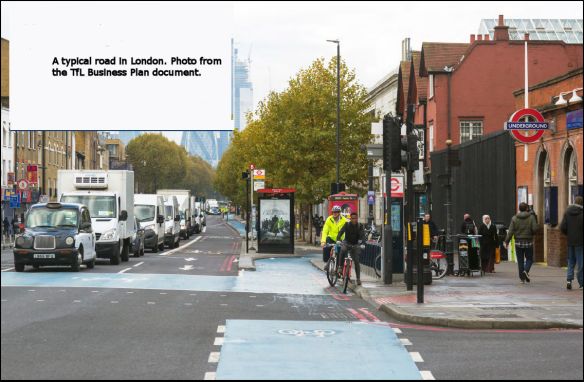
A good example of the result of his policies is actually shown in a photograph of an east London street in the Business Plan document. A long queue of traffic in one lane with the bus lane unused and few cyclists in the cycle lane! See above.

Roger Lawson

Twitter: https://twitter.com/Drivers_London

You can “follow” this blog by clicking on the bottom right.

Greenwich to Woolwich Road Degradation

Transport for London (TfL) have announced proposals for changes to the A206 between Greenwich and Woolwich that will lead to slower traffic, cause more traffic congestion and raise air pollution. The A206 is the main road between Woolwich and Greenwich. The proposals, which are open to public consultation include these proposals:

  • A new two-way Cycleway which will take up some of the existing road space and run along the south side of the road and remove one of two traffic lanes.
  • Six new pedestrian crossings.
  • Extending the existing bus lanes and new ones to effectively turn a two-lane road into one for all other traffic effective from 7.00 in the morning to 19.00 in the evening (7 to 7).
  • Widening the footway at a number of locations.
  • Closure of Charlton Lane.
  • Speed tables to slow traffic on the A206.
  • Changing the Angerstein Roundabout (the one under the A102 Blackwall Tunnel Approach) to improve safety – see photo below. That includes removing the central “roundabout” and banning turns onto the A102 so as “to reduce traffic volumes”. There have been two fatal accidents there in the last two years.

The ABD’s comments which we have submitted to the consultation are:

  1. There are certainly some parts of this road that could be improved for pedestrians and cyclists and the addition of a few pedestrian crossings may be justified. However, pedestrian crossings should be justified based on the number of pedestrians crossing the road at the given point, the difficulty of doing so and the volume of traffic.
  2. The Angerstein Roundabout is certainly a poor design at present as it is even difficult for vehicles to navigate if the driver is unfamiliar with the layout and HGVs are involved. Changing it to remove the roundabout and simply making it a signalised junction does make sense. However we object to the removal of turns onto the A102 as it is not clear what the alternative routes might be for larger vehicles and it might encourage the use of narrow side streets by other vehicles.
  3. We object to the use of speed tables, or any other form of speed humps, particularly on major roads such as the A206 and those used by buses. They generate severe discomfort for vehicle users and for bus passengers.
  4. We doubt the claim that these changes will not cause significant traffic delays, and particularly object to the prioritisation of the needs of cyclists (who only make up 5% of the road users according to TfL) over other road users.

You can read more details of the proposals and respond to an on-line consultation from this web page: https://consultations.tfl.gov.uk/cycling/greenwich-to-woolwich/

Make sure you object!

Note as usual with TfL consultations no information on the cost of the proposals is provided, nor any cost/benefit analysis. Please complain about that also.

Twitter: https://twitter.com/Drivers_London

You can “follow” this blog by clicking on the bottom right

London Congestion – It’s Only Going to Get Worse

London Population Trend

As anyone who has lived in London for more than a few years probably knows, the population of the metropolis has been rapidly rising. This has resulted in ever worse congestion not just on the roads but on public transport also. The roads are busier, rush hours have extended and London Underground cannot handle the numbers who wish to travel on some lines during peak hours. Even bus ridership has been declining as the service has declined in reliability and speed due to traffic jams.

The Greater London Authority (GLA) has published some projections of future population numbers for the capital and the conclusion can only be that life is going to get worse for Londoners over the next few years.

The current population is about 8.8 million but is forecast to grow to 10.4 million by 2041, i.e. an 18% increase. This increase is driven primarily by the number of births and declining death rates. The relatively high numbers of births in comparison with what one might expect is because London has a relatively youthful population. One can guess this is the case because of the high numbers of migration from overseas which results in a net positive international migration figure while domestic migration to/from the rest of the UK is a net negative, i.e. Londoners are being replaced by immigrants.

But population increase in London does not have to be so. The chart above shows you the trend over the last 100 years and as you can see London has only recently reached the last peak set in 1939. During the 1960s to 1990s the population fell. What changed? In that period there was a policy to reduce overcrowding in London and associated poor housing conditions by encouraging relocation of people and businesses to “new towns”. But when Ken Livingstone took power he adopted policies of encouraging more growth. His successors have continued with those policies and have promoted immigration, e.g. with Sadiq Khan’s “London is Open” policy.

Many Londoners complain about the air pollution in the London conurbation without understanding that the growth in businesses and population have directly contributed to that problem. More people mean more home and office heating, more transport (mainly by HGVs and LGVs) to supply the goods they require, more emissions from cooking, and many other sources. The Mayor thinks he can solve the air pollution issues by attacking private car use and ensuring goods vehicles have lower emissions but he is grossly mistaken in that regard. The problem is simply too many people.

Building work also contributes to more emissions substantially so home and office building does not help. But the demand for new homes does not keep pace with the population growth resulting in many complaints that people have to live in cramped apartments or cannot find anywhere suitable to live at all. Likewise new public transport capacity does not keep pace with the increased demand. There is some more capacity on the Underground but only on some lines and not much while Crossrail which might have helped has been repeatedly delayed.

The economy of London is still buoyant.  But all the disadvantages of overcrowding in London mean that Londoners are poorer in many ways. Those who can move out by using long-distance commuting or relocating permanently thus leaving London to be occupied by young immigrants.

Any Mayor who had any sense would develop a new policy to discourage immigration, encourage birth control and encourage emigration to elsewhere in the UK or the Rest of the World. But I doubt Sadiq Khan will do so because a poorer population actually helps him to get elected.

If Sadiq Khan wanted Londoners to live in a greener, pleasanter city with a better quality of life then he would change direction. But I fear only intervention by central Government will result in any change. In the meantime those who live in London might like to tackle their potential MPs, Greater London Assembly Members and prospective Mayors for what they would do about the problems covered in this article.

Go here for more details of the GLA projections of London’s population: https://data.london.gov.uk/dataset/projections-documentation

Twitter: https://twitter.com/Drivers_London

You can “follow” this blog by clicking on the bottom right.
Shepherds Bush and Kensington Consultation Responses and TfL Budgets

The Mayor and Transport for London (TfL) have published the results of their consultation on proposed changes to roads in Shepherds Bush and Kensington (Wood Lane, Notting Hill Gate, etc). The proposed changes will increase journey times for road users and hence also increase congestion – see https://tinyurl.com/yzxhb9m8 for our original report. As one person commented on that article: “Another example of the Mayor’s determination to punish the motorist under the misguided ploy of improving air quality. This latest proposal will in fact worsen air quality by delaying traffic flow”.

The TfL Consultation Report also correctly quotes our comments on the consultation where it says we “Was very critical of the online consultation material, branding them a ‘disgrace”. There were no costs given for the scheme and the questions were biased to get the required answers.

There were 5,386 response to the consultation and many people agreed that it would encourage cycling, walking and use of public transport. That’s hardly surprising is it when they realised that private vehicles will be delayed.

The consultation was also biased because there were 58,539 emails sent out to people asking them to respond but it was only sent to “people who use public transport or cycle in the area”. In reality Oyster Card and Contactless customers, so private vehicle owners were excluded.

Even with all this manipulation, they still managed to get 2,151 people who argued that the proposals would cause traffic congestion or delays, and 1,565 people who said the proposals would worsen air quality. There were also particular concerns about the Holland Park area and the removal of trees.

The London Borough of Hammersmith & Fulham supported the proposals but Kensington & Chelsea borough have objected. TfL have developed revised proposals which include saving more trees and discussions are continuing. At least this shows how strong local opposition to a scheme can cause TfL to reconsider. But the whole process of TfL consultations is ethically flawed.

You can read the TfL Consultation Report here: https://consultations.tfl.gov.uk/roads/wood-lane-notting-hill/ 

Crossrail delays and TfL budget impact

Other news is that TfL have announced that Crossrail (the Elizabeth Line) opening date is to be delayed yet again and it not going to open until 2021. It was originally scheduled to open in 2018. Problems with signalling systems seem to be the cause, and costs are ramping up so it is now likely to come in at over £18 billion. This demonstrates how large rail projects are enormously expensive and are approved with over-optimistic budgets and projected timescales. This is why HS2 should be cancelled now before even more money is wasted on a scheme with a poor cost/benefit ratio.

The additional delay to Crossrail opening will result in another big hole in TfL’s budget because there were many millions of pounds of income expected from fare paying passengers on the new line.

But TfL have devised one way to improve their cash income. They are changing the auto top-up level for Oyster Card users from £10 to £20. This will mean that TfL will be holding much higher balances of customer money than before. The exact impact has not been disclosed but I hope to report more information on this at a later date.

Twitter: https://twitter.com/Drivers_London

You can “follow” this blog by clicking on the bottom right.

The Latest On Hammersmith Bridge

Hammersmith Bridge in west London has been closed since April due to critical safety problems. This was a key part of the road network in west London and was used by 20,000 vehicles per day including many buses. There has been discussion between TfL and the London Borough of Hammersmith and Fulham on what to do about the bridge, and it could cost as much as £120 million to restore the bridge to support previous traffic levels, or even more if it was substantially reinforced.

Construction work may not start until 2021 and it might take 3 years to complete so it looks like local residents will have to put up with the closure for some considerable time. However there is one alternative which gives a better solution. That is to build a temporary bridge alongside the existing one. This might only cost £5 million and could be put up very quickly. See https://tinyurl.com/y4fyrjwj for an article in the New Civil Engineer for more information. The Mayor says it is seriously being considered.

I am sure all readers will support prompt action on this matter, and a commitment to fund the projects. But note that tolls may be imposed on the bridge to fund the work required.

Twitter: https://twitter.com/Drivers_London

You can “follow” this blog by clicking on the bottom right.

Sadiq Khan’s Election Manifesto – Have Your Say

The Labour Party are inviting everyone to have their say on Sadiq Khan’s Manifesto for re-election as London Mayor in 2020. You can read about his achievements to date and submit answers to their questions via this web page: https://tinyurl.com/y29yu999 . It is of course a very biased document like all consultations that Mr Khan presides over, but anyone can respond – you don’t need to be a Labour Party member.

Perhaps the Mayor is short of ideas to ensure he gets re-elected. His last big vote winner was freezing public transport fares but after three years of holding the tide back of inflation in King Canute fashion he has managed to dig a deep hole in Transport for London’s finances which simply cannot continue. Bus services are being reduced as a result while traffic congestion increases. His policies on Congestion Charging and the ULEZ will impose higher costs on many Londoners with minimal public health benefit. He has also clearly failed to tackle rising violent crime and not solved London’s housing problem – indeed his only proposal for the latter is to introduce rent controls which would make matters worse.

But he does admit to increasing the Council Tax Precept (what you pay to the Mayor from your local council taxes) to the maximum allowed. No thanks Mr Mayor. All his other claimed achievements are quite trivial in relation to the problems Londoners perceive as key issues.

All the way through the document, the Mayor emphasises that he has limited powers over many aspects and clearly wants more. But it would be very dangerous to give him more.

Here are some of the questions and how you may care to respond to them (I have only covered those questions that are relevant to transport):

Environment and Climate Change:

Question: How do we take the next steps to clean up London’s air and oversee a massive shift from polluting cars to walking, cycling and electric vehicles at the same time?

Answer: concentrate on fixing the vehicles over which you have control and which are major contributors to air pollution, i.e. diesel buses. You also need to tackle air pollution on the Underground. Otherwise any measures should be justified on cost/benefit grounds and scare-mongering over an imaginary public health crisis as the justification for higher taxes should be stopped. The expansion of the ULEZ to the North/South Circular should be halted and the introduction of more Cycling schemes that create more traffic congestion (and hence air pollution) should be halted.

Transport:

Question: How else can Sadiq make London’s transport system affordable and accessible to all Londoners?

Answer: Stop wasting money on schemes with very poor cost/benefits (such as the proposed Rotherhithe bridge and most of the Cycle Superhighways the finance for which has to come out of public transport fares. He needs to stop spending money and imposing taxes on road users to make the transport system more affordable for everyone. That includes halting the investment in 20 MPH speed limit schemes and cycle schemes that have poor cost/benefits. He should also cease support of road-pricing and workplace parking levies.

Question: What are the future major schemes that Sadiq could focus on delivering?

Answer: The Silvertown Tunnel is one which will be a major benefit for east London. Repairing the Hammersmith Bridge is another for West Londoners. Improving major east-west and north-south road routes such as the Embankment rather than degrading them with 20 MPH speed limits and cycle lanes should be another key objective.

Question: What more can be done to promote walking and cycling?

Answer: Some youth elixirs for the elderly and inform would help and concealing the dangers or cycling is another. That is of course just a witty response to a proposal that is unnecessary and has major disbenefits.

Question: When asking for more powers and devolution from Government on transport issues, where should Sadiq focus his energies?

Answer: Give the Mayor powers to introduce policies to reduce the population of London so as to reduce pressure on the transport, housing and public health systems. Specifically redistribution of business and people out of London and powers to reduce immigration and encourage birth control.

He should also argue for a commitment to devolve more powers to local boroughs so as to avoid TfL dictating local borough policies and more funds financed by central Government to be given to local boroughs solely to be used on improving the road network in London. In addition the Mayor should be given the power to set sensible minimum parking standards for new developments (not maximum ones) in London boroughs.

Those are just a few ideas to help Mr Khan, or indeed his opponents, to get elected.

Twitter: https://twitter.com/Drivers_London

You can “follow” this blog by clicking on the bottom right.

Is a Pelican Crossing Justified at the War Memorial Junction in Chislehurst?

OLYMPUS DIGITAL CAMERA

A petition signed by over 500 people has been submitted to the London Borough of Bromley. It requests a push-button request for pedestrians (a “Pelican” crossing) be installed at the traffic light junction on the A222 – the Chislehurst war memorial junction. The petition is to be discussed at a full council meeting on the 14th October.

Is such a change justified and what would be the impact?

Anyone familiar with the junction will be aware that this is a heavily congested part of the road network in Bromley. It is key route between Sidcup and the A20 into central Bromley and vice versa. During rush hours queues of traffic back up from the existing traffic light controlled junction to the A20 in the mornings, and back down Summer Hill in the evenings. This already causes some vehicles to take routes on narrow roads around the junction, e.g. via Bull Lane/Church Lane/Watts Lane or via Prince Imperial Road/Ashfield Lane. Traffic on the other arms of the junction (the A208) also experiences lengthy queues during busy times of the day.

However, there are common complaints that pedestrians perceive it as unsafe or difficult to cross at the junction, e.g. schoolchildren heading for Coopers School or St. Nicholas Primary School from central Chislehurst, or disabled people. The schools have clearly supported this petition.

It is obvious that the current junction cannot cope with the current volume of traffic but plans to improve it have always been blocked by the Trustees of the Chislehurst Commons who are reluctant to give up land to enable widening of the junction.

The impact of incorporating a pedestrian phase into the existing traffic lights might be very significant and it would presumably need to be installed on all four arms of the junction. Traffic modelling could be undertaken to see the likely impact on traffic delays and vehicle throughput, but that is quite expensive to undertake.

How should one judge the merits of this proposal? Like all allegations of road safety hazards, one should start by looking at the accident record and try to determine the likely cost/benefit. The last time I looked at the detail statistics related to road traffic accidents in Chislehurst, this junction had been the scene of a number of accidents and the A222 is like many of London’s A roads in that it runs through heavily congested areas with pedestrians often present. Thus Perry Street has seen several fatal accidents and there was one at the Memorial junction when the traffic lights had failed in the night. You can see other accident information at the junction by looking at the Crashmap web site (www.crashmap.co.uk).

Many of these accidents are not at the junction itself but some distance away as pedestrians choose to cross elsewhere than at the traffic lights or vehicles collide for other reasons. Clearly a review of the latest police reports of road casualties (the STATS19 records) could be examined for more information, but I do not recollect that there have been any serious accidents involving pedestrians at the junction itself.

I suspect the answer would be, if such an analysis as I suggest be done, that the cost/benefit of spending money on a change to this junction would not be justified, particularly if the value of the additional delays to vehicles was taken into account as they should be. It is also unlikely that pedestrians would change their habit of not crossing at the junction lights.

There is one simple question that can be answered now though. Do pedestrians actually have any difficulty crossing at this junction? This writer has personally walked across the junction at the traffic lights at least once per week for the last 20 years. I do not find any difficulty in doing so. It just requires one to wait until the lights change.

One can argue that improving pedestrian facilities might encourage people to walk rather than use other modes of transport but I doubt that this would have any significant impact in this case. Nobody who can walk would be deterred from using that junction at present. Do the disabled or visually impaired have some difficulty in crossing this junction? Perhaps but that will be the case even if a Pelican Crossing was introduced and the rights of a minority cannot be taken solely into account. The thousands of other people that will be affected by the change have also to be considered. In practice even if a Pelican system was installed at these lights, disabled people would likely have to cross other unsignalized junctions to get to the war memorial crossing.

Readers might wonder who the organisation named Chislehurst Safer Streets are who organised the petition. It is led by Chris Wells who is also a supporter of 20sPlenty and who has campaigned for a wide-area 20 mph signed only speed limit covering Chislehurst. That suggestion has been rebuffed by both Bromley Council and the Chislehurst Society. You can see what Mr Wells had to say about that proposal on the Visit Chislehurst web site. This is what it says about the Atkins study of 20 mph zone published by the Department of Transport (DfT): “In summary, what Atkins found is that 20mph zones that are poorly implemented have little appreciable effect on traffic speed or accidents”. This is grossly misleading. The study was solely focused on signed-only 20 mph schemes and made no comments on how they were implemented – only signs can and are used in such schemes. This kind of special pleading is common among those who are less concerned with the truth than in arguing and winning their case.

Note that Bromley Council had already responded to the petition on the War Memorial junction by Mr Wells. They say that adding a pedestrian phase would “lead to exceedingly long queues at peak times resulting in increased pollution and likely diversion of vehicles into residential areas”. You can read their full response here with details of the Council meeting: https://cds.bromley.gov.uk/ieIssueDetails.aspx?IId=62672&PlanId=0&Opt=3#AI62776 . Clearly diverting traffic onto other narrow roads might be a road safety hazard in itself.

Readers are encouraged to attend the meeting as members of the public, as I shall be doing, or Bromley residents should contact their local councillors. It is important that those who shout loudest do not override a sensible and rational analysis of this issue and the needs and views of the vast majority of the residents of Bromley and its visitors.

Photo above shows long queues of traffic even at lunchtime on a Tuesday.

Roger Lawson

Twitter: https://twitter.com/Drivers_London

You can “follow” this blog by clicking on the bottom right.

Keep The USA Moving

The USA is traditionally where the motor car is king as public transport has been sparse while roads have been built to cope with demand. But it is changing with some cities introducing Vision Zero to improve road safety and policies called “Complete Streets” and “Road Diets”. Vision Zero is well known in the UK as it has been adopted for example in London but with minimal or zero impact (see https://tinyurl.com/y39v6nsy for a previous article on that subject).

Complete Streets are designed to make it easy to cross the street, walk to shops, and bicycle to work. They encourage more walking, cycling and use of public transport. Road Diets involve reducing the number of traffic lanes to provide wider sidewalks (pavements) or the addition of cycle lanes and bus lanes.

Some cities such as New York are also considering introducing congestion charges to cut traffic and reduce congestion.

In other words, US cities are moving in the same direction as cities in Europe and copying London despite the fact that the policies in London have actually increased traffic congestion rather than reduced it and otherwise damaged the transport network. But opposition to such policies is growing. There are particular concerns about the impact on businesses and on access by emergency service vehicles, but there is general opposition to the increased traffic congestion such policies create. This web site covers the issue well and includes a video showing how fire tenders are blocked: https://tinyurl.com/y67gjzjg and emergency service vehicles delayed. It also has an interesting chart showing how the adoption of Vision Zero in Los Angeles appears to have resulted in an increase in pedestrian fatalities.

But opposition is growing. See this web site for a national view (which also includes an interesting note on the Delphi Technique to manipulate public opinion): https://www.keeptheusmoving.com/

In Los Angeles there is a local group opposing such measures who are holding a conference on October 5th – see https://www.keeplamoving.com/ . It’s some years since this writer personally visited Los Angeles but there was horrific traffic congestion then on some freeways and other roads. Reducing road widths to support cycling just seems nonsensical to support a very small proportion of the population when distances people travel to work or to shop is so high. US cities are designed around the use of motor vehicles and the population are not going to change their ways.

I won’t be attending the conference in person but I have submitted a short video which discourages US residents from following the path taken in Europe. Go here to view the video: https://youtu.be/LxEkiycYQ04

Roger Lawson

Twitter: https://twitter.com/Drivers_London

You can “follow” this blog by clicking on the bottom right.