Party Manifestos and London

Yesterday (25/5/2017), UKIP published their General Election Manifesto. That completes the quartet of the main parties, so it seemed an opportune time to analyse and comment on them so far as they affect transport in London. That is of course the sole concern of this blog so any diversion into wider political issues will be avoided so far as is practical.

UKIP. Let’s start with UKIPs (subtitled “Britain Together”) as that contains more specifics than the other parties and has a separate Chapter on Transport. It suggests they would:

  • Scrap HS2 on the basis that it is unaffordable, will blight homes and will only save a few minutes on a London to Leeds trip.
  • End all road tolls on the basis that they are an unfair burden on the already highly taxed road user. That would presumably include scrapping the London Congestion Charge, the ULEZ and proposed tolls on the Dartford and Blackwall Crossings.
  • They oppose the proposed new Thames Crossing at Thurrock and would move it further east through Canvey Island.
  • They would encourage zero emission vehicles by providing more supporting infrastructure.
  • They would prevent diesel vehicle owners from being penalised through higher taxes and parking fines, but they support a diesel scrappage scheme and incentives for diesel vehicle owners to exchange them for electric or hybrid models.
  • They do not support the expansion of Heathrow Airport and would encourage the expansion of smaller regional airports (such as development of Manston in Kent).

In summary, it’s very much a “pro-motorist” transport agenda.

Another aspect of their manifesto is the commitment to “balance migration”, effectively reducing inward migration to zero over 5 years (and thereafter only a “one in, one out” policy as the media dubbed it). This would of course relieve the pressure in the longer term on the transport network (both road and rail), which suffers from major congestion in London mainly because of massive increases in passenger demand in recent years. 

Conservative & Unionist (“Forward Together”). This party’s manifesto is short on specifics, perhaps because their policies are very much a continuation of existing ones and because they seem to be relying more on the winning personality of Theresa May rather than vote winning policies. But there are a few comments on transport as follows:

  • They will continue to invest £40 billion in transport projects, including: a) HS2, b) Northern Powerhouse Rail, c) Expansion of Heathrow Airport, d) Development of the strategic road network including extra lanes on motorways.
  • They want almost every car and van to be zero emission by 2050, and will invest £600 million to achieve it by 2020.
  • Rail capacity will be increased (but the specifics are lacking).
  • More money to support cycle networks and cycle parking at railway stations will be provided. (How much? It does not say).

Yes that seems to be about it.

Labour (“For the Many, Not the Few”). As one might expect, the Labour Party has a strong commitment to invest more in infrastructure, communications and energy systems. That includes:

  • Completion of HS2 to Leeds/Manchester and then on to Scotland.
  • A new Brighton Main Line.
  • Build Crossrail 2 in London.
  • Bring the railways back into public ownership (i.e. renationalise them).
  • They will cap public transport fares, introduce free Wi-Fi across the rail network and stop driver-only operation of trains.
  • They will support investment in low emission vehicles.
  • On airport capacity in the South-East, they “welcome the work done by the Airports Commission” and don’t seem to rule out expansion of Heathrow if noise and air quality issues “can be addressed”.
  • They will “refocus” the roads building and maintenance programmes on “connecting communities” and “feeding public transport hubs”.
  • There will be a stronger focus on road safety improvement targets with “bold measures” to improve safety standards.

How some of this programme might be funded I will leave others to comment on.

Liberal Democrat (“Change Britain’s Future”). The Liberal Democrats focus on “clean air and green transport”. Specifics include:

  • Support for a diesel scrappage scheme and encouragement of the swift take-up of electric and driverless vehicles.
  • Extending Ultra Low Emission Zones (ULEZs) to ten more cities.
  • All PHVs and buses in urban areas to run on ultra low or zero emission fuels within 5 years.
  • Reform of vehicle taxation to encourage electric and low emission vehicles.
  • Establish Government run companies to take over Southern Rail and Govia Thameslink due to severe failings of existing franchisees.
  • Proceed with HS2, HS3 and Crossrail 2.
  • Support the takeover of metro services in London by London Overground.
  • They are opposed to expansion of Heathrow, Stansted or Gatwick and want to improve regional airports.
  • Design cities as safe and attractive walking spaces.

To summarise therefore, all the parties support the promotion of zero emission (electric) vehicles. They all support more rail capacity in one form or another, but only UKIP would specifically cancel HS2. UKIP is “against” more things as one might expect from a populist protest party whereas the Conservatives have gone more for a “positive vision” with lots of the written equivalents of “sound-bites” using words such as “strong”, “stable” and “prosperous”. Actually interpreting what these fine words will mean in practice can be more difficult. The Labour and LibDem manifestos are very much in their traditional mode and hence might appeal more to their existing supporters than new ones. The impact of any party which might win the national election might be limited in London though as the Mayor is very much a dictator and can introduce his own policies and taxation (disguised as “charges”) to a great extent.

Perhaps it might be better to have a right-wind central Government to control the excesses of a left-leaning Mayor (look at some of the quite disastrous changes under Livingstone). But no doubt readers can all make their own minds up after reading the manifestos which are all available on the web.

Roger Lawson
UK Air Quality Plan

On the 5th May the Government published a Revised Air Quality Plan to tackle NOX emissions, in response to breaches of EU legal limits. London Mayor Sadiq Khan promptly slammed it in the Evening Standard as being “woefully inadequate”. He argued it was a public health emergency and criticised the Government for being unwilling to take bold action. He is of course moving aggressively forward himself with the ULEZ plans.

What does the Government’s document actually say? It correctly argues that air pollution can come from a range of different sources, not just transport. However as regards NOX it does exceed legal limits on some roads and diesel vehicles are one of the main causes. It points out that although emissions have been falling, driven by Euro Standards for new vehicles, these measures were side-stepped by the fact that “real world” emissions did not match the test figures. In some cases, e.g. Volkswagen, they were deliberately manipulated to give erroneous data for diesel emissions. This is why there is still a major problem with diesel vehicles and high air pollution.

As it says: “None of this is the fault of those who chose to buy diesel vehicles and as we tackle this problem, these same people should not be penalised for decisions they made in good faith”. Mr Khan is ignoring that though.

The Government is committed to provide incentives and the adoption of policies that will clean up the vehicle fleet. It also argues that as air pollution is often a localized problem one approach should be the introduction of Clean Air Zones that could introduce control of the worst polluting vehicles (in essence HGVs and buses). They also want to encourage the take up of Ultra Low Emission Vehicles (e.g. electric ones).

One measure they suggest would help in addition to generally improving and smoothing traffic flows, might be the removal of road humps. Now that would be a great step forward so far as this writer is concerned – I have repeatedly campaigned against them for the last twenty years. They have no real road safety benefits if you take into account traffic diversion while they have a number of disbenefits – increased air pollution is one well known aspect.

The Government argues that Clean Air Zones should only include charging arrangements where there is no other alternative – again Mr Khan is not taking much notice of this.

The Government mentions the possibility of a diesel vehicle scrappage scheme but suggests that it would need to be closely targeted, limited in scope, provide value for money and minimise the risk of fraud. Author’s comments: Somehow I don’t think my 4 year old diesel Jaguar XF is going to be covered under any such scheme. And I won’t be able to claim dire poverty or some other excuse for a Government subsidy. So I might have a very hefty bill to replace it well before I otherwise would due to the ULEZ impact.

Motor manufacturers welcomed the Government’s proposals – perhaps because they see the opportunity to sell more vehicles to those being forced to replace them. Others were more critical and an RAC spokesperson said it possibly gave the green light to enable lots of local authorities to introduce charging schemes.

In summary, it seems diesel vehicles will be discouraged by higher taxation and discouraged in other ways also. The day of the all electric vehicle is surely coming closer, while even petrol car sales may start to decline.

Roger Lawson

Air Pollution and the ULEZ – More Information

The revised ULEZ proposals are subject to a public consultation which closes on June the 25th. I made some initial comments on it here: https://freedomfordrivers.blog/2017/04/04/mayors-latest-announcements-on-ulez/

The intention was to provide some more comments after I have obtained more information on the costs and benefits of the proposals from Transport for London (TfL). So after no initial response from TfL I submitted an FOI ACT request which included this question: “Could you please also provide the costs of implementing the ULEZ (i.e. the capital cost) and the other proposals and the revenue and profits, i.e. surplus over operating costs in future years, forecast to be obtained by TfL as a result”. This request was refused on the grounds of commerciality sensitivity. I have disputed that rejection on the basis that it is of major public interest to know that information before people respond to the consultation, and also that as this request was handled under the Environmental Information Regulations it is not a valid cause for rejection. It will now go to an internal TfL review and after that probably to a complaint to the Information Commissioners Office. But the outcome of these appeals will not probably be known until after the date of the consultation is closed. Certainly that is likely to be too late to educate the population of London on the facts before they respond. In effect, we have a very dubious concealment of the cost/benefits of the proposals and how much profit the Mayor and TfL might generate from this new regime.

But here are some further comments based on what information is available in the current consultation documents.

It suggests that there would be a 30% saving in NOX emissions in central London in 2019 by bringing forward the ULEZ proposals. Most of the savings would come from HGVs and buses, plus to a lesser extent from vans. Emissions from cars would only reduce by 8%. The major reduction would be in central London, but there would also be benefits in inner and outer London due to trips extending to/from those areas and the change to the vehicle fleet encouraged by the ULEZ rules.

There would also be reductions in PM10 and PM2.5 (particulate) emissions, particularly the latter. But these are still relatively small – for example a 7% reduction from cars in central London, and only 2% across the GLA area.

The document does give some indication on the “damage cost savings” that might result. This is the savings on the calculated costs of the current level of pollution. These could be as high as £15.8 million in central London to as low as £10 million. They give a mid-point estimate of £28 million for the whole GLA area. They provide very little information on how those figures have been calculated. But without knowing the cost of the ULEZ scheme to the road users and the required TfL infrastructure, plus their running costs, it is impossible to say whether there is any overall benefit to the population.

In addition, please note the relatively low benefit from including cars of any kind within the ULEZ proposals.

In my view, these proposals are out of proportion to the benefit to be obtained, at least so far as the impact on car owners and drivers are concerned. The fact that TfL are apparently reluctant to disclose the financial budgets for this scheme suggests to me that it is more about tax raising than simply tackling the air pollution health issue.

So if you will be affected, please respond to the consultation which is here: http://www.tfl.gov.uk/airquality-consultation . PLEASE MAKE SURE YOU RESPOND AS SOON AS POSSIBLE

Roger Lawson

Air Pollution, Oxford Street Buses and Nanoparticles

The Government wished to delay publication of its revised UK Air Quality Plan until after the General Election but after a legal challenge it was forced to publish it. See https://consult.defra.gov.uk/airquality/air-quality-plan-for-tackling-nitrogen-dioxide/ on how the Government plans to improve nitrogen dioxide emissions in particular.

London Mayor Sadiq Khan promptly slammed the proposals as “woefully inadequate” before he could have barely had time to read the full document (air pollution is a technically complex matter and it is necessary to read the whole document and the supporting evidence). In the Evening Standard he said: “I welcome that the government has agreed to consult on introducing a targeted diesel scrappage fund, as I have modelled, to help drivers who bought diesel vehicles in good faith. However, the government has failed to give a firm commitment and, even if it goes ahead, this alone would go nowhere near fixing the problem. City Hall analysis shows that the proposals still mean air quality will be at illegal levels until at least 2026.”

I will provide further and more considered comments on the proposals at a later date.

Meanwhile I am still awaiting a response to my FOI Request on the ULEZ proposals so as to enable a properly considered response to be made to that. It should arrive by the 10th May, but we will see.

In the meantime Transport for London (TfL) has taken steps to reduce pollution on Oxford Street (which is one of the worst locations in London) by introducing proposals to cut the number of buses by 40%. TfL says bus numbers can be reduced because of higher underground frequencies and the new Crossrail service which will open in December 2018. The consultation is present here:

https://consultations.tfl.gov.uk/roads/oxford-street/?cid=oxford-street . Comments: it is undoubtedly the case that the number of buses on Oxford Street not only makes it a very unpleasant street for pedestrians but also creates road safety dangers. Current diesel buses are of course some of the worse emitters of air pollution. Whether the proposals will improve matters substantially is not at all clear.

Another step to improve air pollution in London is the introduction of rapid electric vehicle charging points. TfL has appointed five suppliers to build such a network. These charge points can recharge a vehicle battery in 30 minutes and the plan is to have 300 installed by 2020, although some will be dedicated for use by taxis. All new London taxis must be zero-emission by January 2018.

The latest environmental scare story is the impact of nanoparticles on human health. An article in the New Scientist reported that these microscopic particles can enter the blood stream and they can remain there for over 3 months. The impact they have on health was unknown but the hypothesis given was that they could be having a major impact. In effect the article suggested that we might need to worry not so much about Nitrous Oxides or larger particulates, but about nanoparticles from vehicle pollution.

Nanoparticles are quite difficult to detect, but it is known that they are present everywhere. Indeed normal activities in the home, business activities and certainly industrial activities give off large amounts of nanoparticles which are simply invisible.

A very interesting article in the Financial Times on the 29th April explained how our homes can actually be one of the most polluted locations, often worse than the air outside even in the worst polluted cities. It said “A study published in the European Respiratory Journal in 2012 showed that concentrations of some air pollutants can be up to five times higher indoors than outdoors“. As we spend 90% of our time indoors, versus 10% outdoors, this is of concern. Cooking on gas, food cooking emissions, dog hairs, dead skin particles, lint particles from tumble dryers, deodorant sprays  and scented candles were all named as culprits. Log burning stoves are a particular problem which have become popular even in London of late. The solution is apparently to purchase an electric air purifier.

In summary, pollution is everywhere and always has been. Even green fields and trees can be a menace because of pollens and dust. Indeed I do recall reading a study many years ago that showed the prevalence of asthma was more common in rural areas than in cities.

So it’s easy to become paranoid about air pollution. It’s necessary to separate fact from fiction so that the picture is clear about which pollutants are of real concern and which are not. Otherwise we will get lost in a fog of hysteria.

Roger Lawson

Mayor’s Latest Announcements on ULEZ

On the 4th April the Mayor of London, Sadiq Khan, made his latest announcements on how he intends to reduce air pollution from road vehicles in London. Not a mention of how he intends to reduce the 50% of air pollution caused by things other than road transport which is still growing as the population of London increases, but let us say no more about that for the present.

Mr Khan has revised his previous proposals somewhat, presumably based on the last public survey which did show overall support for his proposals with some reservations. But he is now definitely committed to:

– The introduction of a “T-Charge” of £10 for older vehicles (pre-2006) commencing in October this year. This will only apply within the existing Congestion Tax area of central London.

– The introduction of an Ultra Low Emission Zone (ULEZ) for all vehicles from April 2019, which will again only apply to the central London zone and replace the “T-Charge” mentioned above. The ULEZ daily fee to drive in the zone will apply 24 hours a day, 365 days a year and apply to all vehicles that do not meet the following standards:

a) Petrol Euro 4/ IV

b) Diesel Euro 6/ VI

c) Powered Two Wheelers Euro 3

These standards mean that petrol cars more than around 13 years old in 2019, and diesel cars over 4 years old in 2019 will have to pay a charge which will be £12.50 for cars, vans and motorbikes, and £100 for heavy vehicles such as HGVs and coaches.

They will be in addition to the Congestion Charge where applicable. The ULEZ will apply to all vehicle types, except black taxis, which are already being made cleaner through licensing restrictions. From next year all new licenced taxis must be zero-emissions capable.

Unlike the Congestion Charge, which only applies for limited hours on weekdays, these charges will apply all the time. So trips into central London for the evening will cost you £12.50.

There is again a public consultation on the above which everyone who drives in London should respond to and it is present here: http://www.tfl.gov.uk/airquality-consultation . PLEASE MAKE SURE YOU RESPOND AS SOON AS POSSIBLE. 

In addition to the above the Mayor is considering expanding the ULEZ to nearly all of Greater London in respect of heavy diesel vehicles such as buses, coaches and lorries to be implemented in 2020. Also he proposes to consult on extending the ULEZ to all other vehicles including cars within the North/South Circular, to be implemented in 2021. So you could be paying £12.50 just to drive within that ring road, although a lot of the previous respondents to the last consultation suggested a lower charge.

Mr Khan is calling on the Government to deliver a nationwide diesel vehicle scrappage scheme but there is no sign yet that the Government is listening. There is some concession to residents who live within the ULEZ and for disabled vehicle users who will have a “sunset” period until 2023.

Comment: some information required to make any intelligent comments on these proposals is not apparently available. For example what is the likely impact of these proposals on the level of air pollution within the zone or outside it? What is the cost/benefit justification? What is the cost of implementing this scheme and how much revenue and profit will TfL obtain from it as a result?

These questions are very important because the Mayor has a very strong financial interest in these proposals as the additional charges will no doubt raise much needed revenue for the Mayor and TfL whose budgets are currently under pressure.

It is most regrettable that this is yet another example of asking the public’s views on a matter without giving them the full facts to enable them to make a reasoned judgement on the proposals.

I have asked TfL to provide this information and will let you know if I receive it.

But having walked the streets of the City of London last week I certainly think something needs to be done about air pollution because my lungs were definitely affected and I have not suffered from asthma for many years. The problem was that all the roads such as Cannon Street, Eastcheap, Bishopsgate and around Aldgate were just gridlocked in the middle of the day with stationary traffic which consisted mainly of buses, LGVs, taxis and private hire vehicles. This happens quite regularly now because of the impact of the Cycle Superhighways, road closures, removal of gyratories and other measures promoted by the previous Mayor and local authorities over the last few years.

Vehicles may have been getting cleaner, only somewhat confounded by the Government’s misconceived promotion of diesel vehicles so as to save CO2 emissions. But if transport planners create gridlock then the inevitable will happen – air pollution will continue to get worse until only zero emission and expensive electric vehicles are allowed. We also need to tackle other sources of air pollution and the best way to do that is to stop the growth in the London population or even reduce it.

Postscript: on 9/4/2017:  This interview with Professor Tony Frew, a respiratory expert on TalkRadio is definitely worth listening to if you want the facts about air pollution and its sources: http://talkradio.co.uk/news/sadiq-khans-40000-pollution-deaths-year-zombie-statistic-and-isnt-true-says-respiratory

Julia Hartley-Brewer whom conducted that interview also attacked the promotion of the 40,000 deaths per year in the UK from air pollution in an article in the Daily Telegraph on the 7th April. She said “This 40,000 figure is alarmingly high. It is also alarmingly wrong”.

And as of today I am still awaiting a response from TfL on the data requested giving the data on the impact of the ULEZ on air pollution. Not even an acknowledgement of my request so far so I have submitted a Freedom of Information Act request.

Roger Lawson

Diesel Vehicle Petition

Please would you consider signing this petition in support of clean diesel cars:

https://petition.parliament.uk/petitions/182686

Modern diesel cars are very clean indeed and manufacturers have been encouraged to invest in clean diesel technology in the rush to minimise CO2 emissions.

The attacks on diesel cars are particularly aggressive in London while ignoring the fact that they are so much cleaner than they used to be and that most of the worst pollution from diesel vehicles in London comes from HGVs, LGVs, buses and taxis. In addition they ignore the emissions from many other sources such as home and office heating, industrial processes, etc.

This petition is already doing very well and in the few days it has been live has gained over 3,000 signatures. It is currently growing at some 1,000 a day and is gaining recognition in the media.

Please would you support this petition by signing it, supporting it, and also share it as widely as possible requesting your contacts to do likewise.

Roger Lawson

Air Pollution and the ULEZ

The EU Commission has given the UK a final warning over air pollution in the country. That particularly covers London but also 15 other cities. Similar warnings have been given to Germany, France, Italy and Spain. There are persistent breaches of NO2 limits and the European Commission may decide to take legal action if they fail to act within two months. If not the UK could be taken to the Court of Justice of the EU, although that is one Court that will be affected by the UK departing from the EU. The UK Government is to publish a revised plan to deal with the problem in April.

Meanwhile London Mayor Sadiq Khan is not waiting for that. He has published the results of the public consultation on a new Emissions Surcharge and extensions to the Ultra Low Emission Zone (ULEZ). The proposals were covered in our last newsletter (Dec 2016) and would impose major extra costs on road users of many kinds in London. The consultation was done without any data on the likely benefits in terms of reduced pollution, and without any cost benefit analysis.

With such biased information being provided, one might expect that the result would be as the Mayor desired. Here’s a brief summary of the results (go here for the full data: https://consultations.tfl.gov.uk/environment/air-quality-consultation-phase-2/?cid=airquality-consultation ).

  1. From 23 Oct 2017 some older vehicles will be required to pay a surcharge of £10 to enter the Congestion Charge (a.k.a. Tax) zone. This is called the Emission Surcharge (ES or “T”-charge). They have provided a web site to enable you to check your vehicle for compliance with this and the ULEZ. This is now definitely proceeding as it was a statutory consultation. 63% of respondents supported it, with 30% opposing. Most also supported the proposed start date.
  2. Other consultation questions were non-statutory and there will be another consultation on these soon. One question was on the proposal for an earlier implementation of the ULEZ to 2019. This received 63% support versus 29% opposed.
  3. A third question was on expansion of the ULEZ to within the North and South Circular. This received support from 59% of respondents versus 34% opposed. There was similar support for bringing that in during 2019.

Lastly the latest document from TfL repeats the very dubious claim that “The equivalent of around 9,400 deaths per year in London are attributed to air quality related illnesses”. This is simply wrong and exaggerates the scientific research that has been reported. It confounds possible contributory factors with actual “causes” of death. There is probably some impact on life expectancy from living and working in higher air pollution in London, but the impact is not nearly as clear cut as that and may simply mean some shortening of life in heavily polluted areas.

Note: there are about 48,000 deaths per year from all causes in London. Not a single one has air pollution assigned as a cause of death.

For example this is contained in a report from Clean Air in London: “The Department of Health estimates Bromley (6.1%) has the lowest death rate in London attributable to air pollution and Westminster (8.3%) has the highest” but that is based simply on categorising illnesses and causes of death as being affected to a lesser or greater extent by air pollution. So lung cancer is included even though the vast majority of deaths from it are undoubtedly caused by smoking. There could of course be other reasons from the differences between Bromley and Westminster related to life styles and the demographics of the two populations.

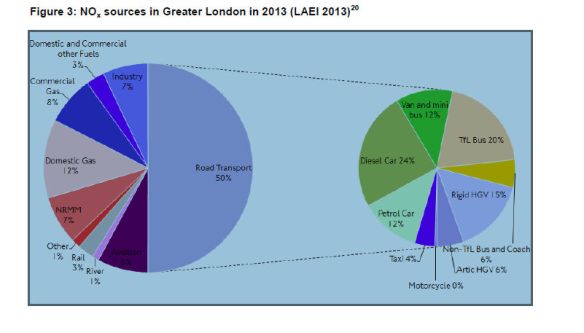
Even if all cars were banned from London, there would still be very considerable air pollution from buses, taxis, HGVs, domestic heating, commercial activities, rail transport, etc, as you can see from the chart below.

air-pollution-sources-london

The message though from these facts is that cleaning up the rest of London’s air to be as good as Bromley’s could only reduce the health impact of air pollution to a limited extent at best and the other demographic factors might mean there is no improvement in mortality . The cost of doing so may be outweighed by the other benefits on which money could be spent to improve the health of the community. For example on the NHS which is clearly desperately short of money as the national media keep telling us of late.

Roger Lawson

Westminster Diesel Parking Charge

The London Borough of Westminster is to trial an increased on-street parking charge for diesel vehicles. It will be a trial scheme in the Marylebone/Fitzrovia areas starting in April. Diesel vehicles will pay an extra 50% on the normal charge of £4.90 per hour.

The object is stated to improve air quality by deterring diesel vehicle usage and ownership. The additional money raised will be used to subsidise public transport schemes.

There are potentially two problems with this. Firstly it looks like a revenue raising measure when the law is quite clear on this matter (see Camden v. Cran and the more recent Barnet case). The Acts of Parliament that enable councils to charge for parking do not permit “revenue raising” measures.

Secondly, how will parking enforcement staff know whether a vehicle is diesel powered or not? Some models can be powered by either and the badge on them may not differentiate. Will parking attendants have access to DVLA records or will they be relying on the honesty of vehicle owners?

Hammersmith & Fulham

Diesel surcharges for permit parking are also an issue in the Borough of Hammersmith & Fulham. Councillor Greg Smith, Leader of the Conservative Group on the Council, had this to say at a recent meeting: “It is nonsensical from an environmental perspective. Diesel cars are simply not the worst offenders for putting nitrogen dioxide and nitrous oxide into the air. The worst offenders are aircraft and heavy goods vehicles, with buses and black cabs also contributing.”. He suggested the Council should encourage renewal of domestic boilers to cut pollution.

He also said “Bizarrely from a party who are supposed to be about fairness and the redistribution of wealth, it is deeply unfair to those who can least afford to change their vehicle AND beneficial to the owners of more expensive, fuel inefficient cars.

Indeed, we must ask ourselves why is it that a Labour Council is taxing the owner of a diesel Ford Fiesta on Crookham Road in my ward more, but the £119,000, 16 feet long Porsche Cayenne Turbo S parked next to it gets a tax break by still only paying £119 a year, despite taking up five feet more in length! Or perhaps they are proud of wanting to charge the owner of the 75mpg Skoda Fabia on Mimosa Street more to park, but the £132,000, 15mpg, 550hp, 5.0 Litre V8 Supercharged Petrol, Range Rover SV Autobiography parked next to it less.

Is that what the Labour Party has become? Champion of the supercar? Promoter of the Porsche? Friend of the Ferrari? All great cars, but it just doesn’t add up with what they say they are trying to achieve.

To be generous, Labour are confused on this matter. To be more accurate, I think they are engaged on a mission of spite – desperate for a headline, but without any substance or foundation.”

Comment: Yes these kind of taxes are token environmental gestures when there is little data provided on what the benefit will be. So as so often these days we get policies promoted without any proper cost/benefit analysis and the cost of introducing these schemes is simply ignored. It’s truly “gesture politics” of the worst kind.

Westminister Council is also a particularly bad example of a lack of democratic accountability and information provision. Try searching their web site for information on these proposals, reports on the topic, minutes of meetings that considered the issue, public consultations, or ways to object etc. You can’t find anything!

Roger Lawson

Diesel Permit Parking Surcharge in Merton

The London Borough of Merton are proposing to introduce a surcharge on all Parking Permits where the vehicle is diesel powered. It has already been approved by Councillors although the decision has been called in for scrutiny at a meeting on the 14th December.

Although the increased charge would be phased in over some years, the surcharge may be as much as £150 which would treble the existing cost for car owners in Merton.

The Council is doing this in the name of attacking the level of NOX emissions and resulting negative health impacts. However, the report they have commissioned and published on this subject leaves out a lot of the evidence necessary to make an informed decision on the matter. For example, a quick analysis revealed that this policy may only reduce such emissions in the longer term by 0.4%. A negligible figure and which might even be impossible to detect.

Why should diesel vehicle owners who require on-street parking be penalised when those with off-street parking or who drive in from outside the borough are not? It’s simply irrational and smacks of “gesture politics” of the worst kind.

Perhaps it has more to do with economics because it would raise revenue for the council when council budgets are so under pressure. But unfortunately raising permit parking charges to do that is illegal which has been backed up by several legal case precedents.

Or of course it may be simply an attack on car owners in one of the few ways that Councils can do so. Regardless, any residents of the Borough of Merton should complain to their local Councillors and attend the council meeting on the 14th December to see what transpires.

You can read the full ABD’s submission to Merton Council on this matter here: http://www.freedomfordrivers.org/ABD_Letter%20to%20LBB%20Merton%202016-12-02.pdf

Roger Lawson

Mayor Calls for Congestion Charge on VW

London Mayor Sadiq Khan has asked that Volkswagen pay £2.5 million for “missed” congestion charge payments after the emissions rigging disclosures. He suggested that was the figure owners avoided paying by claiming a discount for a low emission vehicle when they were nothing of the sort. Vehicles affected are Audi A1 and A3, Skoda Fabia and Octavia, Seat Ibiza and Leon, and VE Golf and Polo cars.

Comment: the Mayor said “if you don’t ask you don’t get”, but of course there is no threat of legal action or formal claim. It looks like political posturing as the chance of making this stick legally is surely very low. It is the owners of the vehicles who claimed the discount on the basis of the information available to them and in good faith. Is the Mayor going to go back to them and ask for more money? I don’t think so. It is also arguable that the real life emissions of the vehicles concerned were indeed low and hence would have qualified anyway.

Roger Lawson