Leon Daniels Promotion of Cycling, and Vision Zero Failing

OnLondon have published a very interesting talk by Leon Daniels  – see link below. He was the former Managing Director of Surface Transport for TfL and “acted extraordinarily quickly” to implement the Cycle Superhighways. Indeed he suggests that he might have barged them through without properly considering the views of all interested parties and assessing the outcomes properly.

The reason he gives for their implementation was to cut the number of cyclist deaths on London’s roads and to tackle the air quality issue by encouraging more cycling. But he concedes that the cycling infrastructure has had a negative effect on bus speeds and “indeed for all traffic”.

His solution to end the war between different kinds of road users is a “self-healing” city although it’s not totally clear what he means by that.

Comment: Cycle superhighways and other cycling infrastructure have not cut cycling deaths and cycling is still very much the interest of a small minority so the reallocation of road space to them has had negligible impact on traffic. Indeed it has caused more traffic congestion and hence more air pollution. It was clearly a poorly thought through policy with unintended consequences.

You can read Mr Daniel’s talk here:

https://www.onlondon.co.uk/leon-daniels-london-cycling-and-the-self-healing-city/

Vision Zero is one of the policies being pursued by TfL to reduce road casualties. It promotes traffic speed reduction among other things. We have commented previously on how ineffective it has proved to be – see https://freedomfordrivers.blog/2019/07/29/mayors-vision-zero-strategy-failing/

Now there is similar evidence from the USA. Vision Zero is aimed at reducing deaths and serious injuries to zero, but in major US cities who have adopted the strategy they are far from achieving their target. In fact cyclist and pedestrian casualties in the USA have been increasing and the figures for individual cities show there are very mixed result. See https://www.citylab.com/newsletter-editions/2019/11/citylab-daily/602455/ and here  https://www.motorists.org/blog/do-vision-zero-programs-equal-more-traffic-accidents/ for details.

Vision Zero was a policy invented in Sweden in 1997. To quote from an OECD report on accident figures in Sweden: “The longer-term trend for road deaths in Sweden has been downwards trending. Between 2000 and 2018, the number of annual road fatalities fell by 45%. However, the trend in the decline of traffic fatalities has stagnated since 2010. The road fatalities total for 2018 is actually a 21.8% increase on 2010’s total”. It would seem that the policy is failing in Sweden also now.

Comment: Vision Zero is probably failing because it is like all simplistic road safety policies pursued by well-meaning but ignorant politicians. Having an objective which is widely publicised without a clear view on what measures will actually achieve it in the long-term is not helpful. Vision Zero seems to be diverting road safety resources from what is known to work to policies that don’t.

Roger Lawson

Twitter: https://twitter.com/Drivers_London

You can “follow” this blog by clicking on the bottom right.


More Air Pollution Scaremongering from the British Heart Foundation

The British Heart Foundation (BHF) have issued a press release which claims that heart attack and stroke deaths related to air pollution could exceed 160,000 by 2030. The charity says air pollution presents a major public health emergency which the Government must urgently address.

What is the basis for this claim? It relies on an “estimate” of deaths attributable to particulate air pollution and on research they have funded. One of those research studies looked at how nanoparticles of gold were absorbed into the blood after inhalation and were retained for some time. They claim this is analogous to PM2.5 particulates in vehicle emissions. But they don’t prove any link to actual heart disease or deaths. Other studies of the impact of small particulates have failed to show any impact on health or life expectancy.

The BHF is a typical large charity that raised £138 million last year. Only 72% of the money raised was actually spent on medical research or other charitable activities. The rest was spent on fund raising. It is a very professionally run organisation with a well-designed web site. The CEO got paid £211,105 in 2108-19.

They are effectively using such scare-mongering to raise funds for the charity by running a “toxic air campaign” if you look at their web site. In other words, they have a direct financial incentive to promote this idea and exaggerate the impact of air pollution on health. They have jumped on the bandwagon of all the air pollution scaremongers.

Vehicles will no doubt get the blame for these scares, but in reality air pollution from vehicles has negligible impact on people’s health or life expectancy. See https://www.abd.org.uk/air-quality-vehicles-truth/ for the evidence.

Twitter: https://twitter.com/Drivers_London

You can “follow” this blog by clicking on the bottom right.


How to Rack up a £11,970 Bill at the Dartford Crossing

Below is an email we have received from a user of the Dartford Crossing. We have removed the sender’s name for reasons that will become apparent.

“I am in a serious situation financially that within the next month will probably see me lose my house and my family as this I have kept to myself for over a year and now I am at a tipping point with no way to escape.

Here goes…

I live in Kent and work in Essex, so have to go both ways most days using the Dartford Crossing, I was fortunate to have a company car for 3 years prior which was automatically paid for so I never had to worry or even think about paying the Toll, the journey was just the norm.

However personal Tax and Tax on my fuel card led me to no option but to ditch the company car and buy my own car. So I just carried on doing the journeys.

At this point I was also desperately trying to sell my house and purchase a new house, and I had not got a lot of money so was just living month to month.

Then the letters started coming through the door – a £2.50 charge was now £35, and a £5 a day one was now £70. When you get 3 or 4 at once you then all of a sudden get £280, then more and more come through, and that’s when you realise that you have not paid. After years of doing it naturally you just don’t think… I spoke to my company and they said they would put my car onto their auto pay account, but I don’t think they did that for a week or so, so more fines came through.

Now I was in a situation of not being able to pay, as I had so many fines. This is where it gets even more out of hand, as I could not afford to pay so it escalated and all of a sudden it was sent to the courts and ended up with Bailiff company (JBW) pursuing me. Each £2.50 crossing then became £197. The Bailiffs turned up at home so I started to find the money. I took out credit cards so that I could pay the debts as I was getting letters and texts everyday.

Things got even worse just after Christmas when the company removed all private cars off of the scheme, and didn’t tell us until a week later, so that meant more fines…

In total I had 67 crossings (about a month’s worth) not paid … all innocent mistakes as I just didn’t think at the start because I had never needed to pay…

It would have cost £167.50.

I am now having to pay off £11,970.59.

In which £6814.50 is the Dart Charge fees.

And £5156.50 are Bailiff fees.

I have currently paid £4,652.09, without my partner knowing, but because of the pressure this has meant I have fallen into arrears with Council Tax and my mortgage too…

I have to pay another £200 next week otherwise I will break my agreement but I can no longer cope with the pressure of hiding it, and I know I can’t pay it next week so the Bailiffs will be at my door…

To date I have now paid the equivalent of 1860 crossings. It was an innocent mistake now I will lose everything. I wrote to my local MP at the start of all the letters for help, and they only advised to make sure I pay the Bailiff on time.

I am only writing this to warn people that debt spirals, and pressure spirals”.

Comment: This is indeed a sad case and shows the problems that can arise with camera enforced payment systems which we have consistently opposed because of the large numbers of accidental infringements that arise.  This is one good reason (there are several others), why tolls on such crossings should be removed. It is of course worth signing up for the Dart Charge Autopay system if you use the crossing regularly.

Twitter: https://twitter.com/Drivers_London

You can “follow” this blog by clicking on the bottom right.

Are You Suffering from London Throat?

An article in the Daily Telegraph today (9/1/2020) suggests that if you have a constant foggy feeling with repeated coughs and colds then you are suffering from a hitherto unknown disease called “London Throat”. The suggestion is that this condition arises from breathing in polluted air and very specifically inhaling brake dust that damages the immune system, thus preventing the cells called macrophages from clearing away bacteria.

The research on which this claim was based was carried out by Dr Liza Selley and published in the journal Metallomics. Apparently the concentration of tiny metal particles in brake dust is three times higher on roads with speed humps due to the repeated braking they induce.

Comment: If there is such a cause then those who live, work and travel in London are much more likely to have suffered from exposure to particulates on the London Underground where levels of dust pollution are very high and are known to have high concentrations of metal particles.

However, the removal of speed humps which the Telegraph article suggested as a solution, and has also been recommended by NICE to cut pollution, would certainly be a good idea. We have consistently opposed speed humps on the grounds that they generate more air pollution but also for many other reasons. See this web page for a full analysis of how damaging and effective they are:  https://www.freedomfordrivers.org/speed-humps.htm

Roger Lawson

Twitter: https://twitter.com/Drivers_London

You can “follow” this blog by entering your email address below.

RideLondon Event – Should it Continue?

The RideLondon event, sponsored by Prudential, is a fun day for cyclists which has been running since 2013 and has created enormous inconvenience for residents and businesses in Surrey and in South West and Central London. Roads are closed or rolling road blocks used, particularly on the route taken by professional riders. The number of amateur riders also effectively generates gridlock on the roads involved.

Numerous people have objected in the past and a petition has been organised on Change.org to oppose the event. See https://www.change.org/p/surrey-county-council-stop-surrey-being-turned-into-a-cycle-track

Now Surrey County Council have woken up to the concerns expressed and are undertaking a public consultation on whether to continue with it. See https://www.surreysays.co.uk/deputy-ceo/survey-on-prudential-ridelondon-surrey/

Note that the event has involved deaths in the past, and not just to riders. In 2017 a pedestrian was struck by a cyclist and later died. The roads are not closed to pedestrians and even many of the amateur cyclists consider it to be a race.  We are opposed to all road closures for leisure or sporting events. They should be kept open for essential services and the general use of the public.

There is simply no justification for such road closures.

Make sure you respond to the Surrey Council Consultation!

Roger Lawson

Twitter: https://twitter.com/Drivers_London

You can “follow” this blog by clicking on the bottom right.

Greenwich to Woolwich Road Degradation

Transport for London (TfL) have announced proposals for changes to the A206 between Greenwich and Woolwich that will lead to slower traffic, cause more traffic congestion and raise air pollution. The A206 is the main road between Woolwich and Greenwich. The proposals, which are open to public consultation include these proposals:

  • A new two-way Cycleway which will take up some of the existing road space and run along the south side of the road and remove one of two traffic lanes.
  • Six new pedestrian crossings.
  • Extending the existing bus lanes and new ones to effectively turn a two-lane road into one for all other traffic effective from 7.00 in the morning to 19.00 in the evening (7 to 7).
  • Widening the footway at a number of locations.
  • Closure of Charlton Lane.
  • Speed tables to slow traffic on the A206.
  • Changing the Angerstein Roundabout (the one under the A102 Blackwall Tunnel Approach) to improve safety – see photo below. That includes removing the central “roundabout” and banning turns onto the A102 so as “to reduce traffic volumes”. There have been two fatal accidents there in the last two years.

The ABD’s comments which we have submitted to the consultation are:

  1. There are certainly some parts of this road that could be improved for pedestrians and cyclists and the addition of a few pedestrian crossings may be justified. However, pedestrian crossings should be justified based on the number of pedestrians crossing the road at the given point, the difficulty of doing so and the volume of traffic.
  2. The Angerstein Roundabout is certainly a poor design at present as it is even difficult for vehicles to navigate if the driver is unfamiliar with the layout and HGVs are involved. Changing it to remove the roundabout and simply making it a signalised junction does make sense. However we object to the removal of turns onto the A102 as it is not clear what the alternative routes might be for larger vehicles and it might encourage the use of narrow side streets by other vehicles.
  3. We object to the use of speed tables, or any other form of speed humps, particularly on major roads such as the A206 and those used by buses. They generate severe discomfort for vehicle users and for bus passengers.
  4. We doubt the claim that these changes will not cause significant traffic delays, and particularly object to the prioritisation of the needs of cyclists (who only make up 5% of the road users according to TfL) over other road users.

You can read more details of the proposals and respond to an on-line consultation from this web page: https://consultations.tfl.gov.uk/cycling/greenwich-to-woolwich/

Make sure you object!

Note as usual with TfL consultations no information on the cost of the proposals is provided, nor any cost/benefit analysis. Please complain about that also.

Twitter: https://twitter.com/Drivers_London

You can “follow” this blog by clicking on the bottom right

Keep LA Moving and the Impact of Delays to Emergency Vehicles

Back in September I mentioned a conference in Los Angeles, USA, focused on “Road Diets” and “Vision Zero” and other negative transport policies under the title “Keep LA Moving”. There is strong opposition to road schemes that increase congestion and remove road space in the USA. You can see some of the videos taken of panel sessions at the conference in October here:  https://www.keeplamoving.com/conferencevids but what follows are some of the key points from presentations shown at the event.

Fire truck

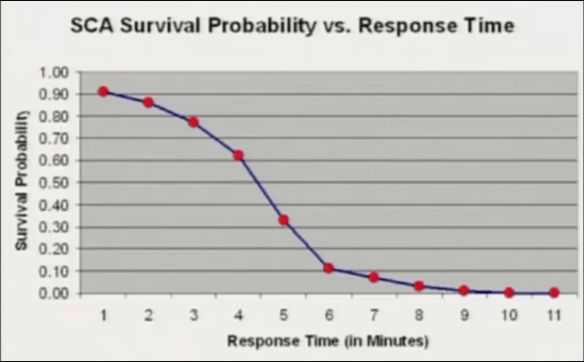
One presentation shown was from Les Bunte, former Assistant Fire Chief in Austin, Texas which covered the impact of delays in response times to medical emergencies – specifically to cardiac arrests. The delays to emergency service vehicles are a major concern to those opposed to increases in traffic congestion caused road space removal. He presented this chart:

SCA Survival

In England there is a target ambulance response time to Category 1 emergencies such as heart attacks of an average of 7 minutes which the country consistently fails to meet, and there are of course many responses that take longer than 7 minutes. In London the times are undoubtedly worse although I could not find any recent data on that subject as the London Ambulance Service does not report against the national target. All they report is that for Category A emergencies, 95% of ambulances arrive within 19 minutes. But you can see from the above chart that any response time of more than 10 minutes means you are almost certain to die.

Another presentation shown at the LA Conference was from the Portland Fire Department. According to the National Fire Protection Agency in the USA, in 2016 there were 35,200,000 emergency calls to fire departments around the country. Almost 22 million of these were fire and medical emergencies. Delays can have fatal consequences.

Delay to emergency response also means firefighters arrive at the scenes of emergencies in more dangerous conditions. In 2017, almost 59 thousand firefighters incurred injuries, and 60 firefighters died – most of which occurred at fireground operations. A number of fire fighters have also been injured from hitting the roofs of their cabs, rushing to emergencies when encountering speed humps.  At least two of these firefighters have been placed on permanent disability

The chart below compares the number of vehicle related deaths – pedestrians, cyclists and vehicle passengers (2018 stats) with the average yearly deaths caused by sudden cardiac arrest (SCA – not considering victims of other medical emergencies) plus fires in the USA. SCA and fires are Class A emergencies, requiring the most urgent emergency response times.

The data shows that a person is nearly 10 times more likely to die from fire and cardiac arrest than ALL vehicle-related accidents involving pedestrians, cyclists and passengers of cars. Clearly it is very important to maintain fast response times to medical emergencies.

USA Fatalities

This is quite conclusive evidence of the negative impacts of delays to emergency vehicles caused by road narrowing, speed humps and other traffic calming measures that increase traffic congestion and slow emergency services.

Roger Lawson

Twitter: https://twitter.com/Drivers_London

You can “follow” this blog by clicking on the bottom right.

Delivery Consolidation in the City and New Traffic Signs Manual

There were a couple of interesting items for readers in a recent edition of Local Transport Today.

Firstly the problem of emissions from delivery vehicles (HGVs and LGVs) in the City of London is being tackled by plans for “consolidation centres”. That would mean fewer individual trips by motorised vehicles with the last mile being covered by cargo bikes or even on foot. The City of London Corporation has identified three possible locations for “last mile logistic hubs” – the London Wall car park, the Barbican Trading Estate and Middlesex Street car park.  I am not even sure what they mean by the Barbican Trading Estate although there are some large car parks in the Barbican Centre. However most of those are accessed via Beech Street which will be a zero emission road soon.

As regards the London Wall car park, I am familiar with that as I use it occasionally but it gets full up already at certain times so removing space for other purposes does not seem a good idea. It is one of the few car parks in the centre of the City and the entrances and exits are not at street level so surely it is far from ideal for heavy cargo bikes.

A new Chapter 6 of the Traffic Signs Manual used by road traffic engineers to help design roads has been issued. Chapter 6 covers junction design and pedestrian signals as well and replaces several “Traffic Advisory Leaflets” issued by the Department for Transport (DfT). It is particularly of interest in respect of the timings of pedestrian crossings and their location. Chapter 6 is only 200 pages – and you thought designing roads was simple.

See https://www.gov.uk/government/publications/traffic-signs-manual for all of the Traffic Signs Manual chapters.

Roger Lawson

Twitter: https://twitter.com/Drivers_London

You can “follow” this blog by clicking on the bottom right.


Travel in London Survey – How It’s Being Made More Difficult

Transport for London (TfL) have released their latest survey of travel patterns in London.  It’s a mine of statistics but the “spin” put on the data is generally grossly misleading. For example, it says “Londoners and visitors make increasingly sustainable choices for how they get around, choosing to walk, cycle and use public transport”.  Walking and cycling have slightly increased – see comments below, but how is public transport “sustainable”? A high proportion of public transport is buses and diesel London buses are a major contributor to air pollution while air pollution on the London Underground is worse than on London’s streets so how is that “sustainable”? Of course there is no definition of “sustainable transport” in the Report  – it’s simply a way for TfL to claim some things as good and others bad.

Total travel demand in terms of number of trips taken has been flat for the last three years despite the continuing growth in the population. In reality Londoners are choosing to travel less simply because traveling in London has become more difficult. Public transport has become overcrowded while private transport (cars and PHVs) are being discouraged in numerous ways.

Bus journeys declined by 1.8% last year probably due to the same reasons as the decline in use of cars – traffic congestion has slowed journey times, making it quicker to walk in many cases.

Cycling in terms of cycled kilometres rose by 5% it is claimed but still only accounts for 2.5% of all trips despite the massive expenditure on cycle superhighways and other cycling facilities. This figure is also distorted by using distance cycled instead of number of trips by that mode. You can see the data more clearly by looking at this chart from the Report:

Per Person Trip Rate

This shows clearly that cycling has not been growing and any alleged increase is simply down to the growth in the population of London. This is what one person had to say on Twitter: “The same tiny number of people cycled 5% further because the weather was a bit nicer than usual that year; at a cost of £millions to taxpayers, while record numbers of Londoners sleep rough and get murdered. In any other setting this would be surreal: but not in Sadiq Khan’s London”.

The Report also claims success in the Mayor’s objective of promoting more “active travel” such as cycling and walking to make us more healthy. As regards walking the above chart shows how walking has declined over the last ten years. And Figure 5.2 in the Report shows that the percentage of people achieving 20 minutes per day of active travel is basically unchanged in the last ten years.

The big trends over the last ten years have been increases in underground patronage – up 25.6% – and national rail usage – up 41.5%. Which explains why you cannot get a seat on the trains or the underground and during rush hours you’ll either be squeezed into the carriages or can’t even get into the station. This has arisen because of a failure to match public transport provision with the growth in London’s population which incidentally is mainly from immigration as the Report spells out.

Bus journeys declined by 1.7% last year and have actually declined by 0.6% over the last ten years. It seems that nobody likes buses. Perhaps it’s that standing in the cold or rain waiting for a bus or unreliable bus arrival and trip times that puts them off – it certainly does this writer.

Motorised road travel declined slightly in inner and central London but rose slightly in outer London. Londoners are apparently reluctant to give up car use despite the ever increasing restrictions on them. One change though is the use of PHVs (mini-cabs) has risen to offset the decline in private cars. For example it is estimated that as much as 40% of car traffic in central London at certain times is accounted for by PHVs, but their numbers are forecast to fall substantially due to removal of the exemption from the Congestion Charge (a.k.a. Tax) and the new ULEZ tax.

The Report notes how serious road traffic casualties increased last year which shows how the Mayor’s “Vision Zero” strategy is failing. But interestingly it also notes that injuries in the London Underground increased by 6% last year to 3,968 while bus passenger injuries declined by 8.6% to 4,889. These are surprisingly high numbers but still less than those injured in road traffic accidents.

Only 56% of London households have access to a car with an even lower proportion in inner London. But this proportion has not substantially changed in the last ten years (see Figure 4.12 in the Report).

The report gives some data on air pollution and in particular of NO2 emissions which mainly come from transport. This has been falling substantially, particularly in central London, mainly due to changes to newer vehicles in the vehicle fleet. See chart below taken from the Report.

NO2 Trends

The Report goes on to claim an impact from April 2019 from the introduction of the ULEZ in central London but in reality the trends in the above chart will simply have continued so any claim for an impact from the ULEZ is a figment of TfL’s imagination. It is simply too early to claim any impact as reliable data is not yet available. And just to remind you, there is no clear medical evidence of any negative impact of NO2 on human health.

In summary although this TfL Report contains some useful data, it misinterprets the trends in London travel patterns and the impact of the Mayor’s Transport Strategy. Most of the changes in travel trends in London have probably occurred from a rising and ageing population.

The report is very selective in both data reporting and interpretation. For example there is no data on traffic congestion which from most users experience has worsened considerably in recent years. That degradation has taken place from policies pursued by TfL which has meant removal of road space from cycle lane installation, widening of pavements, junction changes, more pedestrian crossings and traffic lights and other negative changes.

However an interesting section of the Report is on future travel demand and possible “Scenarios” in Chapter 14. One of the three scenarios is “Accelerating London” with high levels of population growth and immigration, high housing costs and rising crime rates, i.e. more of the same. A second scenario is a “Rebalanced London” with lower economic growth, a stable population size with actual falls in inner London and a slower pace of life. It sounds positively utopian if you read it. The third scenario is “Innovating London” where there is a focus on more technology both in employment and facilitation of travel. It does not say which the Mayor of London might back however.

Regrettably as with anything the Mayor or TfL issue, the Report is more of a public relations document than an unbiased analysis of the trends in London travel and its causes.  It should be read with caution.

You can find the Report here:

http://content.tfl.gov.uk/travel-in-london-report-12.pdf

It just remains to wish readers of this blog Best Wishes for the New Year and a belated Happy Christmas

Roger Lawson

Twitter: https://twitter.com/Drivers_London

You can “follow” this blog by clicking on the bottom right.

Why Cost/Benefit Analysis Is So Important

The world is becoming full of irrationality. Political decisions seem to be driven more by emotion than by science of late and all we see on television news are human interest stories rather than facts and analysis.

This creates an atmosphere where those who shout loudest are listened to while quiet scientific analysis is dumped. Thus organisations such as Extinction Rebellion get lots of publicity and media personalities such as Greta Thunberg get massive coverage however wrong they are.

But emotions drive bad decisions.

Let’s consider the issue of road safety for example. Everyone recognises that there are still too many deaths and serious injuries on our roads, many or which might be avoided. But if we decide this is a major national priority on which money should be spent (i.e. from taxes), where do we spend it? A rational person would say “spend it on the most cost-effective proposals because that way we will save the most lives or injuries for a given amount of expenditure”. Bearing in mind there are limited financial resources in any Government, this has to be the best approach.

But there are various ways to reduce casualties, which includes:

  • Redesigning roads to make them safer, including tackling known blackspots.
  • Improved driver training and tougher tests for new drivers.
  • Improving in-car safety by better engineered vehicles.
  • Improving emergency medical treatment after an accident.
  • Cutting ambulance response times.
  • Reducing traffic speeds that might reduce casualty severity.
  • Exhortations to drivers to take more care with publicity campaigns.

You can probably think of some others that might help but the first four of the above have probably had the most impact in the last few years on casualty reduction. Where should the money be spent? What provides the best cost/benefit ratio is the answer.

At the lower level, if we decide that money spent on improving roads is worthwhile, then where do we spend it? The answer is again simple – on those locations where the money will save the most casualties. But many local councils ignore that approach and simply listen to local pressure groups.

Or at the higher level, should the Government spend money on road safety, on improving hospitals, or on improving home safety. For example about 1,700 people die in road accidents each year in the UK, but there are about 6,000 deaths each year from accidents in the home, and 40,000 deaths from cancer. The latter might be susceptible to more expenditure on treatment or research, while many home deaths are due to falls down stairs. Should the Government invest in lifts for all multi-storey homes or only allow bungalows to be built in future? Some 55% of injuries in the home are burns caused by cooking. Should the Government ban cooking?

You can see how this whole field is a minefield of conflicts of interest and instead of rational analysis people tend to spend money where they think it might help or based on traditional ideas. But the answer is to evaluate the cost versus the benefit on a simple uniform financial measure.

The benefit of saving a life, or a serious injury, can be valued and the Department for Transport regularly publishes their figures for those costs – currently it’s about £2 million for a fatality, £250,000 for a serious injury and £25,000 for a minor injury. One can dispute how it is calculated and how optimistic or pessimistic that figure is, but it does provide some basis for working out how much should be spent on saving a death. In addition there are many more minor accidents than KSIs (about 100 times the fatalities), and minor accidents are easier to value because you can simply add up the medical treatment costs, the lost employment time, the emergency services costs and then ask the victims how much they would have paid to avoid the injury. So the overall costs can be roughly estimated with some accuracy.

A similar calculation is made for many other purposes – for example, what is the benefit of treating a patient with a life saving drug versus its cost? Or how by how many years will their life be extended and how do you value an extension of life? Such calculations are a regular element in public policy decisions, although there are few hard guidelines on the subject at present.

The above indicates how the benefits might be calculated. To offset those one has to work out the costs. That includes in the case of revised road schemes, the construction cost of course, but there are often costs (or savings) imposed on road users. For example, in the recently discussed case of the Chislehurst War Memorial Traffic Lights (see https://tinyurl.com/y56v2rty ) where it was proposed to install a Pelican Crossing, the costs are not just the construction cost but the on-going costs imposed on the road users by the extra delays and traffic queues of having a pedestrian phase in the lights. In addition there are the negative costs of more accidents on minor roads due to traffic diversion to avoid the jams, and more air pollution from the stationary queues of traffic. These can all be estimated.

On the subject of air pollution, we currently have a lot of debate about the impact of that and what should be done to improve it. But there is typically little cost/benefit analysis. In reality, even if all air pollution was removed (an impossible task as a lot of it comes from natural sources), it might only extend the average population life by a few days. Meanwhile in London alone hundreds of millions of pounds of costs are being imposed on residents in the name of solving the problem. The cost/benefit on the ABD’s calculations for the London ULEZ scheme is extremely negative – see https://tinyurl.com/y4w6pwuk for the figures. Even Birmingham Council produced a negative figure when trying to justify their CAZ scheme but they still decided to go ahead.

This is public policy making turned on its head. The fact that both such schemes will generate large amounts of revenue for the Mayor of London and Birmingham Council was perhaps a more important part of their considerations! These “taxes” are an irrational imposition on the public and are not even an efficient way of collecting taxes.

Transport for London (TfL) have even given up on publishing any cost/benefit analyses of most new road schemes mainly because the figures when calculated show that they are simply uneconomic. Or they publish figures that are distorted by not including all the costs – for example on their “Safer Speed” plans.

Public life is being corrupted by the approach of relying on emotion to make decisions or by other motives rather than on a proper cost/benefit analysis. We need more politicians who are better educated and understand these issues, and the general public also needs to become better informed on these matters.

Roger Lawson

Twitter: https://twitter.com/Drivers_London

You can “follow” this blog by clicking on the bottom right.