UK Air Pollution – The Facts

The BBC have published several articles recently on air pollution under the emotive headline “So I can breathe”. But one by BBC Environment Analysis Roger Harrabin is actually quite accurate. It’s title is “How bad is air pollution in the UK?” and his answer to that is “Air pollution is a major contributor to ill health in the UK, but it’s hard to say exactly by how much”.

He says that dirty air does not kill people directly but reports that it is estimated that it shortens the lives of around 40,000 people every year – mainly those who already have heart or lung problems. How accurate are the media headlines about this he asks? He says that claming that pollution kills 40,000 people is just wrong and it’s also wrong to say pollution is rising. The 40,000 is also a statistical construct with a lot of uncertainty involved – it might a sixth as big – or twice as big.

Air pollution in the UK has been dropping, but in London recommended NOx levels are still regularly breached and levels at the roadside have barely dropped at all.

He says diesel cars are portrayed as the main villains and the biggest proportion of pollution does come from road transport in general. But if you look at Greater London, private diesel cars only contribute 11% of NOx. Lorries produce a similar amount and in central London only 5% of NOx comes from diesel cars while 38% comes from gas used in heating homes and offices.

Mr Harrabin does suggest some solutions to the problem which you can read in the full article here: http://www.bbc.co.uk/news/science-environment-38979754. It’s well worth reading as it debunks many of the myths spread by the Mayor of London, TfL and others.

If the Mayor persists in attacking diesel cars and other smaller vehicles while doing little about air pollution from heating, industrial processes and other big transport emitters such as HGVs, LGVs, buses and planes then he will be wasting our money.

Roger Lawson

Air Pollution and the ULEZ

The EU Commission has given the UK a final warning over air pollution in the country. That particularly covers London but also 15 other cities. Similar warnings have been given to Germany, France, Italy and Spain. There are persistent breaches of NO2 limits and the European Commission may decide to take legal action if they fail to act within two months. If not the UK could be taken to the Court of Justice of the EU, although that is one Court that will be affected by the UK departing from the EU. The UK Government is to publish a revised plan to deal with the problem in April.

Meanwhile London Mayor Sadiq Khan is not waiting for that. He has published the results of the public consultation on a new Emissions Surcharge and extensions to the Ultra Low Emission Zone (ULEZ). The proposals were covered in our last newsletter (Dec 2016) and would impose major extra costs on road users of many kinds in London. The consultation was done without any data on the likely benefits in terms of reduced pollution, and without any cost benefit analysis.

With such biased information being provided, one might expect that the result would be as the Mayor desired. Here’s a brief summary of the results (go here for the full data: https://consultations.tfl.gov.uk/environment/air-quality-consultation-phase-2/?cid=airquality-consultation ).

  1. From 23 Oct 2017 some older vehicles will be required to pay a surcharge of £10 to enter the Congestion Charge (a.k.a. Tax) zone. This is called the Emission Surcharge (ES or “T”-charge). They have provided a web site to enable you to check your vehicle for compliance with this and the ULEZ. This is now definitely proceeding as it was a statutory consultation. 63% of respondents supported it, with 30% opposing. Most also supported the proposed start date.
  2. Other consultation questions were non-statutory and there will be another consultation on these soon. One question was on the proposal for an earlier implementation of the ULEZ to 2019. This received 63% support versus 29% opposed.
  3. A third question was on expansion of the ULEZ to within the North and South Circular. This received support from 59% of respondents versus 34% opposed. There was similar support for bringing that in during 2019.

Lastly the latest document from TfL repeats the very dubious claim that “The equivalent of around 9,400 deaths per year in London are attributed to air quality related illnesses”. This is simply wrong and exaggerates the scientific research that has been reported. It confounds possible contributory factors with actual “causes” of death. There is probably some impact on life expectancy from living and working in higher air pollution in London, but the impact is not nearly as clear cut as that and may simply mean some shortening of life in heavily polluted areas.

Note: there are about 48,000 deaths per year from all causes in London. Not a single one has air pollution assigned as a cause of death.

For example this is contained in a report from Clean Air in London: “The Department of Health estimates Bromley (6.1%) has the lowest death rate in London attributable to air pollution and Westminster (8.3%) has the highest” but that is based simply on categorising illnesses and causes of death as being affected to a lesser or greater extent by air pollution. So lung cancer is included even though the vast majority of deaths from it are undoubtedly caused by smoking. There could of course be other reasons from the differences between Bromley and Westminster related to life styles and the demographics of the two populations.

Even if all cars were banned from London, there would still be very considerable air pollution from buses, taxis, HGVs, domestic heating, commercial activities, rail transport, etc, as you can see from the chart below.
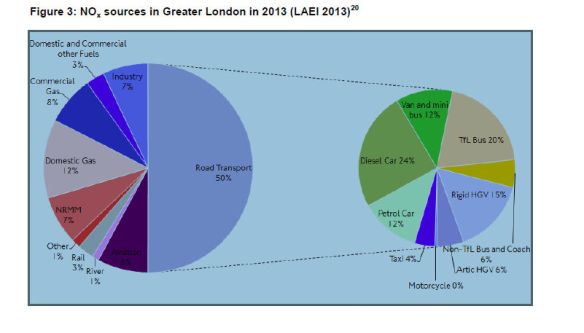
air-pollution-sources-london

The message though from these facts is that cleaning up the rest of London’s air to be as good as Bromley’s could only reduce the health impact of air pollution to a limited extent at best and the other demographic factors might mean there is no improvement in mortality . The cost of doing so may be outweighed by the other benefits on which money could be spent to improve the health of the community. For example on the NHS which is clearly desperately short of money as the national media keep telling us of late.

Roger Lawson

Speed Humps and Air Pollution

Air pollution from motor vehicles, particularly in major conurbations such as London, has been a hot topic of late. The impact may be exaggerated but it has certainly become a matter of public concern with the increase in diesel vehicles allegedly making it worse.

It has been known for many years that speed humps actually result in more air pollution. For example this writer published an article back in 2002 which said the following: “Pollution Caused by Traffic Calming. As a contribution to the local debate on the merits of speed bumps, it is worth covering a report produced by the  TRL (Transport Research Lab.) last year. In the past, different studies in different countries seemed to produce very diverse results, but the latest methodology seems more likely to have produced accurate figures. TRL Report No. 482 studies the effect of a number of different traffic calming measures, including road humps, cushions, pinch points and mini-roundabouts. They also studied the impact on traffic flows and delays experienced by fire engines. To quote from the report “The results of the study clearly indicate that traffic calming measures increase the emissions of some pollutants from passenger cars. For petrol non-catalyst, petrol catalyst and diesel cars, mean emissions of CO per vehicle-km increased by 34%, 59% and 39% respectively. For all three vehicle categories the increase in mean HC emissions was close to 50%. Emissions of NOX from petrol vehicles increased only slightly, but such emissions from diesel vehicles increased by around 30%. Emissions of CO2 from each of the three vehicle categories increased by between 20% and 26%. Emissions of particulate matter from the diesel vehicles increased by 30%.”

The advocates of speed humps ignored this negative evidence in their commitment to road safety even though their impact on accidents is very marginal and may be a mirage.

As confirmation for the above a recent study from Imperial College, London also found high levels of pollution from road humps – indeed higher than from other forms of traffic calming (see the Daily Telegraph on the 11/6/2016 for a fuller report on this and some quotes from me).

For example they got 47% more particulates and 64% more NO2 from a petrol car when driven over humps, and even higher figures for diesel cars.

As I pointed out in my comments to the Daily Telegraph, accidents to school children are not particularly frequent outside schools so putting humps there is unnecessary. But the health impact on children of air pollution may be particularly severe. There are numerous reasons why the use of speed humps should be banned and this is yet another – see this page for lots more information written by the author on this topic some years ago (and the facts have not changed since): http://www.bromleytransport.org.uk/Humps.htm

Roger Lawson

London Boroughs to Target Diesel Cars and Political Awareness

Not only will diesel car drivers be targeted by the planned Ultra Low Emission Zone (ULEZ) in central London, they will also find they are paying more to park on their local streets. The boroughs of Islington and Hackney are proposing higher permit parking charges for diesel vehicles – an extra £50 in Hackney and an extra £96 in Islington where they already have an emission based scale of charges. Islington is of course notoriously anti-car in all of its policies and this will impact 9,000 users of diesel vehicles in the borough.

Those who are unhappy should perhaps bear in mind that the Labour Party is currently in control of the Council but that has not always been so, with a long period of no overall control or other parties being dominant. Indeed Islington Council have a very useful web page that tells you how you can stand for election which is usually a good way to get the attention of existing councillors – it is here: http://www.islington.gov.uk/involved/involvedvoting/electionhow/Pages/default.aspx

Those who live in other boroughs should perhaps start to examine the stance of their local councillors on such matters so you know how to vote at election time. Democracy does have an impact if you take the time to use it.

Roger Lawson

Barnet Emissions Based Permit Parking

Barnet Council have finally agreed to pay the £155,000 costs of the legal action brought by David Attfield and his supporters against proposed new parking charges. The council lost the Judicial Review action in the High Court after it was ruled that increases to charges across controlled parking zones (CPZs) in Barnet in order to pay for other transport projects were unlawful. Let us hope other London councils take note of this case. It reinforces the previous legal precedent that all councillors should be aware of – namely that you cannot use on-street parking schemes to generate revenue, i.e. there should not be an intended surplus.

But Barnet has not given up on increasing charges. They are bringing in one of those hated “emissions based permit parking schemes”, i.e. the more emissions your car makes the higher the charge even though no cars emit emissions when they are parked, and the probability of such a charge having any impact on emissions in the borough is very low because it only affects cars parked in CPZs and not those parked off road or elsewhere. This was clearly demonstrated in the London Borough of Richmond but councillors pushed ahead regardless. The ruling LibDem council and its leader were subsequently ejected by the electorate as the measure proved very unpopular (see http://www.freedomfordrivers.org/Richmond.htm for the ABD’s past campaign in that borough).

Roger Lawson

No End To, Rather An Intensification of the War on the Motorist

Drivers had been promised no re-emergence of moves to impose road user charging under the current administration. But by stealth, buried in the bowels of the Infrastructure Bill (currently making its way through Parliament) are measures which: (a) facilitate the privatisation the Highways Agency, and (b) pave the way for the sell-off of the UK road network to private interests, and the subsequent imposition of road user charging.

The threat of a mandatory imposition (by EU diktat) of the fitment of Black Boxes remains. Big Brother external control and monitoring of your driving.

The Government is active in supporting Driverless Car technology: the ultimate extension of external control – you become a passenger in your own vehicle – but still responsible for it if the technology fouls up! (Even Toyota have distanced themselves from this particular piece of crass idiocy).

The much-publicised Motorway Speed Limit increase has been quietly ditched – another example of a commitment made but retracted. A raft of major road speed limit reductions were being propose, ostensibly due to EU clean air diktats; when it was government itself that retarded the decline in emissions: by (a) discouraging catalysed petrol vehicle sales in favour of lower CO2-, but higher NOx-, SO2- and particulate-producing diesel; and (of much greater significance), by (b) persistently failing to regulate adequately the emissions of the worst polluters: public service, and older goods vehicles. Modern private diesel cars have very low emissions – particularly those with DPFs (Diesel Particulate Filters).

Speed Camera Partnerships effectively remain totally unregulated. This is despite incontrovertible evidence that the casualty-reducing benefits claimed for their “electronic highwaymen” prove to be non-existent after Regression To The Mean is taken into account. Of course, turkeys would never vote for Christmas; and instead of seeking reductions in prosecution numbers by lobbying for sensibly-set speed limits, the Partnerships have now switched focus to try to divert as many drivers as possible away from accepting fixed penalties and onto “Speed Awareness” courses – from which both the Partnership and the course organisers each take a tasty rake-off. The Shakespearean words: “Rotten”, “State” and “Denmark” come to mind…….

Ill-informed local politicians are promoting the proliferation of 20mph limit zones (with a few notable exceptions like Worthing – due to overwhelming public opposition ). This is despite the road safety evidence being damningly negative; with deaths and serious injuries consistently being worse than those in comparable nearby areas where 30mph has been retained.

All these developments have to be countered at both local and national levels if we are to prevent things getting markedly worse for drivers than is already the case. You can help by joining in and making your voice, views and opinions heard.