Sadiq Khan Asks for £1 Billion Bail-Out

Sadiq Khan may be asking for as much as £1 billion to bail-out Transport for London (TfL). He did not deny it when interviewed on BBC television. The organisation is haemorrhaging cash as most of its income comes from bus and tube fares and usage of those has severely declined. It may be unable to pay its staff very shortly without some Government support and has already “furloughed” 7,000 staff from today. TfL will be able to access funding from the Government’s Job Retention Scheme for those staff, saving the organisation millions of pounds every week, but that’s only a short-term and temporary solution to the Mayor’s financial problems.

How did the Mayor get TfL into the position where it cannot survive the problems caused by the coronavirus epidemic? In essence because the Mayor is financially inept and has allowed TfL to run up massive deficits so it has minimal reserves to cope with such an event. We have commented on this issue repeatedly – for example here on the TfL budget in January: https://freedomfordrivers.blog/2020/01/17/tfl-business-plan-and-budget-for-the-next-5-years-more-of-the-same/

Total borrowing was forecast to reach £12.3 billion within 2 years because of delays to Crossrail and other issues, and that was before the impact of the coronavirus. A lot of the problem is caused by the Mayor spending money on programmes such as cycle schemes, Active Travel, Healthy Streets, Vision Zero road safety, the ULEZ and other policies for which there was no cost/benefit justification provided in this Mayor’s Transport Strategy (MTS). Now we are seeing the result of this financial incompetence and inability to manage the budget.

We suggest that before the Government hands the Mayor any cash, they should lay down some conditions on how it will be used and insist on some changes to the MTS. Scrapping the expansion of the ULEZ would be a good starting point.

Twitter: https://twitter.com/Drivers_London

You can “follow” this blog by clicking on the bottom right in most browsers or by using the Contact page to send us a message requesting. You will then receive an email alerting you to new posts as they are added.

Climate Assemblies Exposed As Platforms For Extremists

Croydon Citizens’ Climate Assembly wants totalitarian kangaroo climate courts for net zero non-believers. At first it seemed like the LTT article (1) on the London Borough of Croydon Citizens’ Climate Assembly Report was an April Fool joke, but the actual report (2) does contain the following on page 5:

“People who fail to support the law of net zero greenhouse gas emissions should be identified and penalised. We want the majority of socially responsible residents supported and recognised for contributions they make. We also want to see those who let us down identified and penalised.”

It appears that Croydon Council wish to introduce some “thought police” as in George Orwell’s novel to tell us what we should believe.

UK Net Zero policy should be scrutinised by all voters via a proper democratic process including a full cost-benefit analysis (3) rather than by a selected few overseen by biased advisors, which include Extinction Rebellion. In a free and democratic society people are entitled to hold their own views and make their own travel and lifestyle decisions. It’s ridiculous that a supposedly Conservative government is pandering to environmental extremists by supporting the setting up of assemblies dominated by extremists to advise on decisions that will negatively impact the economy and our lifestyles when there is not likely to be any beneficial impact on global CO2 emissions, weather or climate.”

Ends

Notes for Editors

(1) Local Transport Today: Punish people who don’t back net zero: https://www.transportxtra.com/publications/local-transport-today/news/65037/-punish-people-who-don-t-back-net-zero-

(2) Croydon Citizens’ Assembly on Climate Change Report:  https://democracy.croydon.gov.uk/documents/s21475/Appendix%201%20Final%20report%20on%20Citizens%20Assembly%20on%20Climate%20Change.pdf

(3) Petition: Hold a referendum to scrap the UK’s policy of Net Zero CO2 by 2050   https://petition.parliament.uk/petitions/300316

Twitter: https://twitter.com/Drivers_London

You can “follow” this blog by clicking on the bottom right in most browsers or by using the Contact page to send us a message requesting. You will then receive an email alerting you to new posts as they are added.
Decarbonising Transport – A Costly Exercise in Limiting Personal Freedom

Decarbonising Transport Cover

Grant Shapps, Government Transport Minister, has recently published a document entitled “Decarbonising Transport” (see Reference 1 below). From the cover photograph (see above), it suggests that the Government expects us all to travel by electric buses in future with not a private car in sight.

That is actually the agenda spelled out in the document. It follows from the adopted Government policy of achieving net zero greenhouse gases (GHG) by 2050, despite that fact that many people think this is financial lunacy and simply unaffordable. That’s even if you believe that removing all CO2 emissions is essential to stop global warming which is a very dubious proposition anyway.

The document spells out that “Public transport and active travel will be the natural first choice for our daily activities. We will use our cars less and be able to rely on a convenient, cost-effective and coherent public transport network”. If only the latter were true!

Public transport is inherently inconvenient. It never arrives at your doorstep and if it is raining you will get wet walking to the nearest bus stop or train station. You will also get cold in winter waiting for the next bus or train, and may be uncertain when or if it will arrive – public transport is never as reliable as your own vehicle. But the Government is intending to “persuade” you to change your lifestyle.

It also contains this wonderful sentence “Clean, place-based solutions will meet the needs of local people. Changes and leadership at a local level will make an important contribution to reducing national GHG emissions”. What exactly does that mean and what practical measures is it suggesting. This writer has no idea.

It also states that “all road vehicles will be zero emission” and also says “technological advances, including new modes of transport and mobility innovation, will change the way vehicles are used”. Is it suggesting we will all be using electric scooters in future or what?

The Government is developing a Transport Decarbonisation Plan (TDP) which will set out in detail what will need to be done and will be published in Autumn 2020 – the Government is clearly rushing ahead on this policy. The document already published does give a lot of information on the sources of GHG emissions in the UK and the trends in size.

Transport has remained remarkably stubborn to change whereas many other sources such as energy production have fallen in the last few years. Transport is now the largest contributor at 28% of emissions. But cars/taxis emissions have fallen while HGVs and Vans have increased – the latter have grown by 67% since 1990 on more than double mileage. Emissions from cars are projected to fall by 52% by 2050 due to the increased use of electric vehicles. The private motorist is doing what the Government requires however misconceived and expensive it may be.

Meanwhile emissions from international aviation have more than doubled since 1990 and were still increasing prior to the virus epidemic. They might soon exceed emissions from cars. There is no short-term way of cutting aircraft emissions so they are allowed to buy “indulgences” just like in medieval times for their sins. In this case that means purchasing carbon offsets or planting trees under the CORSIA scheme.

The Government is spending billions of pounds on encouraging us to walk and cycle, mainly via local authority schemes. You can see the impact of this in London which had had similar policies and lots of funding since the current Mayor was elected. It has been a very negative outcome with modal shift hardly perceptible except where people are forced to comply by closing roads, restricting parking and other similar measures.

The document highlights that 79% of domestic freight is carried by roads, 13% by water and 9% by rail – the latter two mainly carrying heavy, bulk cargoes. But GHG emissions from HGVs have been rising driven partly by decreasing fuel efficiency. New lower emission targets for HGVs have been set to tackle this problem but the future projections do not indicate a rapid fall. The Government suggests that electric cargo bikes are the answer for local deliveries.

In summary the Government is keen to promote modal shift in the public, whether you like it or not. This is yet another attack on the private car which we have consistently opposed because it is in essence irrational and unnecessary.

You can share your views on decarbonising transport, register for regular updates on the progress of the Transport Decarbonisation Plan and register your interest for the workshops by emailing TDP@dft.gov.uk as well as by following @transportgovuk on twitter.

Please send the Government your views before this nonsense goes too far.

Reference 1: Decarbonising Transport: https://tinyurl.com/s2ohyd9

Twitter: https://twitter.com/Drivers_London

You can “follow” this blog by clicking on the bottom right in most browsers or by using the Contact page to send us a message requesting. You will then receive an email alerting you to new posts as they are added.

Mayoral Election Postponed and Transport Price Freeze Unfrozen

Among last weeks epidemic news and financial turmoil, two important items of news for Londoners sneaked out. First the election for Mayor of London has been postponed – possibly for a year, along with other local Government elections due in May. With Sadiq Khan well in the lead in the polls, that might be welcome news for other candidates as it will give them more time to gather supporters.

One of the current Mayor’s vote winning policies at the last election was his promise to freeze public transport fares. That proved popular with many Londoners despite the fact that it was financially rash and has resulted in a big deficit in Transport for London (TfL) finances and limited investment in new transport services. The Mayor has now decided to drop that commitment but he is committing to limit rises in Underground fares to inflation and continuing to freeze bus fares – if he gets re-elected of course.

Is that wise? One thing he appears to have overlooked is that TfL finances depend to a great extent on fare-paying passengers. Bus trips have been falling and the coronavirus impact will undoubtedly reduce the numbers travelling on London buses and the underground substantially as more people work from home and events in London are cancelled. Nobody is going to be travelling on crowded public transport if they can possibly avoid it by walking, cycling or getting taxis instead.

This might have a very severe short-term impact on TfL’s finances as a lot of TfL’s costs are fixed so any hit to revenue results in big financial losses. But TfL is already loaded with debt due to the fares freeze so may no longer be credit-worthy. That will be a real problem for the new Mayor whoever it is.

Twitter: https://twitter.com/Drivers_London

You can “follow” this blog by clicking on the bottom right in most browsers or by using the Contact page to send us a message requesting. You will then receive an email alerting you to new posts as they are added.

Book Review – Demotorized – A Witty Look at the Use and Taxation of Motor Cars 

Demotorized Cover

“Demotorized” is a new book by experienced motoring journalist James Ruppert. As he describes it himself, it “is partly a giant whinge on behalf of the average motorist” whereas he believes motor cars are a “force for good that outweighs any downsides”. That is certainly what we believe.

The book is a witty look at the history of the automobile and how politicians have taxed them, often using excuses for doing so that have created unintended consequences. Or they have simply misunderstood the technology and the underlying science so that money has been wasted and negative results obtained – such as the push for diesel usage that has now been reversed.

The author takes a close look at the global warming paranoia that is being used to attack personal vehicle use – he clearly does not believe in it at all. He also takes a look at the revenue raising from the pursuit of speeding offences, but unfortunately fails to mention the false statistics on which it was based and how money is being generated by “speed awareness” courses. Indeed he suggests that the latter is a “local authority revenue raiser” when in fact few local authorities currently run such courses – It’s mainly commercial organisations and it’s them and the police who are the main financial beneficiaries. At least that is the current position although there are moves to enable local authorities to get on this gravy train.

There is a good section on the history and future prospects for electric vehicles. The author makes it plain that their economics have yet to be proven.

It’s quite a long book at over 300 pages and a mine of useful information so at £9.99 for the paperback edition it’s good value. But it’s still an easy and amusing read – indeed sometimes it’s difficult to tell whether the author is being serious or not.

In summary a useful book for anyone who wishes to learn more about the motor industry and how the motorist has suffered from perverse government policies.

Twitter: https://twitter.com/Drivers_London

You can “follow” this blog by clicking on the bottom right.

Press Release: Hybrid Cars To Be Banned From 2035

The Government plans to ban sales of new hybrid cars from 2035 along with all petrol and diesel cars. That has been brought forward from the previously planned date of 2040 and will now include hybrid vehicles.

We deplore this over-reaction to the views of the extreme end of the environmental movement. This change in the regulations ignores the whole-life cost in terms of carbon emissions of building, operating and scrapping vehicles. Premature changes will mean more emissions of CO2 not less.

There is also no certainty that by 2035 there will be vehicles available that provide sufficient range, or an adequate network of electric charging points that drivers can rely upon. It will also require a major expansion of the electricity grid to cope with the increased demand. All these changes will impose enormous costs on drivers and the economy, and threaten the very existence of the motor manufacturing industry.

Hybrid vehicles are a good compromise solution to meet the concerns of drivers and ensure that they transition to lower emission vehicles in due course, but this change might actually deter people from buying them. Bringing in tougher regulations might simply ensure that vehicle owners keep their old petrol/diesel vehicles for longer rather than replacing them with new ones, with the unintended consequence that emissions will not fall.

These proposals are part of the Government’s plans to achieve a net-zero carbon target by 2050 which will impose enormous costs on the economy and have no impact on the worldwide emissions. The UK is already a very small part of worldwide emissions and unless major nations such as China and the USA cease using coal in power stations, when they are currently building more of them, there will be negligible impact.

This latest announcement is just another example of “gesture politics” that may kowtow to the whims of environmental enthusiasts in the UK but will in reality have negligible impact apart from inconveniencing the general public.

The Population Growth Problem and Trump at Davos

7.7 Billion and Growing. That was the subtitle of a BBC TV Horizon programme last night on population. Chris Packham was the presenter. He said the world’s population was 5 million 10,000 years ago but by 2050 it is forecast to be 10 billion. He showed the impact of excessive population on biodiversity and on rubbish generation with lots of other negative impacts on the environment. It is surely one of the most important things to think about at present, and will have major economic impacts if not tackled.

The big growth is coming in countries such as Brazil and Nigeria. Sao Paolo is now 5 times the size of London and it’s running out of water. So are many other major cities including London. The growth in population is being driven by better healthcare, people living longer but mainly via procreation. A stable population requires 2.1 babies per family, but it is currently 2.4. In Nigeria it’s 5!

In some countries it is lower than that. It’s 1.7 in the UK (but population is growing from immigration) and it’s 1.4 in Japan where an ageing population is creating social and economic problems.

The FT ran an editorial on the 14th of January suggesting population in Europe needed to be boosted but it received a good rebuke in a letter published today from Lord Hodgson. He said “Global warming comes about as a result of human activity, and the more humans the more activity.  This is before counting the additional costs of the destruction of the natural world and the depletion of the world’s resources. In these circumstances suggesting there is a need for more people seems irresponsible”.

I completely agree with Lord Hodgson and the concerns of Chris Packham. The latter is a patron of a campaigning charity to restrain the growth in population called Population Matters (see  https://populationmatters.org/ ). Making a donation or becoming a member might assist.

For a slightly different view in Davos President Trump made a speech decrying the alarmist climate views and saying “This is a time for optimism, to reject the perennial prophets of doom and their predictions of the apocalypse”. He was followed by a 17-year old with limited education who said just that and got more coverage in some of the media. I believe Trump and moderate environmental writers like Matt Ridley who suggest we can handle rises in world temperature and that the future is still rosy. But we surely do need to tackle the problem of a growing world population.

Too much population has a direct impact on air pollution and traffic congestion in London and the rest of the UK. More people means more vehicles – not just cars and buses but for delivery of goods.

Chris Packham reported how population reduction was done somewhat too aggressively in India and China but there are other ways to do it via education and financial incentives. Just ensuring enough economic growth in poorer countries will reduce population growth to the minimum. Let’s get on with it!

Roger Lawson

(Twitter: https://twitter.com/Drivers_London  ).

You can “follow” this blog by clicking on the bottom right.


TfL Business Plan and Budget for the Next 5 Years – More of the Same

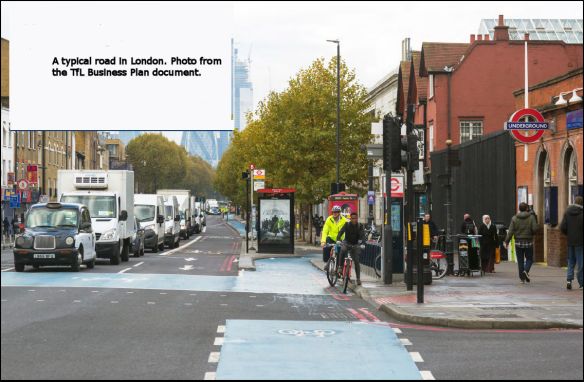
London Road

Transport for London (TfL) have published their Business Plan to cover the next 5 years and a Budget for the next year. The latter has already been approved by the London Assembly.

I shall pick out a few key points from these long documents which are certainly worth reading if you have the time – see https://tfl.gov.uk/corporate/publications-and-reports/business-plan .  Bear in mind that as always, it’s money that drives the political and policy decisions – in this case the apparent desire of the Mayor to build a bigger empire and control more of our lives. So private transport will be discouraged and he wants more money from central Government and from Londoners to fix his self-inflicted budget problems caused by fare freezes, Crossrail delays and reckless expenditure on cycle infrastructure.

The delays to Crossrail and its rising cost run through the whole document like an albatross around the Mayor’s neck. Crossrail is now unlikely to open until 2021 which means £750 million in lost revenue as against that expected, hitting the TfL budget. In addition the delays and extra work means extra costs of up to £650 million and it’s not clear where that money will be coming from. There are very optimistic forecasts in the Business Plan for income from Crossrail – for example £884 million in 2023/24. Will it really be achieved?

Diesel Buses, one of the major sources of air pollution in the capital, are to be replaced to a large extent by 2,000 zero-emission buses by the end of the 5-year business plan period, but the whole fleet will not be zero-emission until 2037. However they will be at least Euro VI compliant soon. There is also a commitment to install 300 rapid Electric Chargers for other vehicles by the end of 2020.

Note that the London bus network has been reduced partly due to falling passenger numbers and income no doubt but there is also a reduction in central London offset by increases in outer London.

TfL Transport Commissioner Mike Brown reiterates the commitment to Vision Zero to reduce road casualties despite the fact that the policy has had negligible impact to date – see a previous blog post on that subject. He also commits to tripling the amount of “protected” Cycling space which will mean more underused cycle lanes. But he is also committing to make 73 junctions safer which may assist cyclists.

Despite cutting operating costs, one of the few good things reported, there will be deficits of £307m, £493m and £513m in TfL (after “capital renewals”) for this year and the two following ones and barely break-even in 2022/23. As a result the Mayor will have to substantially increase borrowing to cover that and large amounts of capital expenditure for both Crossrail and other network improvements. That includes £2.2 billion this year and next year, followed by £1.2 billion each year in subsequent years. Total borrowing will reach £12.3 billion within 2 years. None of this is being spent on the road network of course other than some maintenance.

So far as the road network is concerned, the maintenance of road surfaces including the repair of pot-holes has been reduced in the last two years which the documents concede has caused a deterioration in road assets. However there is a commitment to “gradually restore the condition of highway assets, with a focus on those that contribute more to walking, cycling and public transport” whatever that means. Does that mean they will fund repairs to bus lanes but not the rest of the road?

On Hammersmith Bridge whose closure is causing major problems in West London, the document only says that £25 million has been allocated to pay for preliminary work but no contract will be awarded to repair the bridge until Spring 2020 and it might take several years to complete the work. It is unclear where the money required will come from. The Rotherhithe Tunnel will be refurbished within the next 5 years – cost of around £140 million, and work done on the A40 Westway. Work on the Silvertown Tunnel should commence in 2020 and complete by 2025.

As regards the ULEZ, the Budget document finally discloses some financial figures. In 2018/19, the ULEZ will contribute most of the £215 million improvement in operating income in the current year, but with implementation costs of £58 million, i.e. a net £157 million which is somewhat more than previously forecast (see   https://tinyurl.com/y4w6pwuk ). As the Budget document only covers the year 2019/20 and no details are provide in the Business Plan the impact of the extension of the ULEZ to the North/South Circular is not apparent but the Mayor clearly intends to push ahead with that (assuming he gets re-elected).

The Business Plan indicates that fares income is expected to rise at around RPI which ignores the fact that Sadiq Khan has already promised to continue to freeze public transport fares if he gets re-elected, at least for 2020. So the Business Plan may be totally unrealistic.

In summary the Business Plan and Budget demonstrate an incompetent Mayor and senior management at TfL who wish to get us all cycling, walking or using public transport while the road network gets worse. This results in more traffic congestion and more air pollution which most Londoners would prefer them to fix. The persistent financial mismanagement by the Mayor will also come home to roost sooner or later.

A good example of the result of his policies is actually shown in a photograph of an east London street in the Business Plan document. A long queue of traffic in one lane with the bus lane unused and few cyclists in the cycle lane! See above.

Roger Lawson

Twitter: https://twitter.com/Drivers_London

You can “follow” this blog by clicking on the bottom right.

Latest Political News in London and Beech Street Closure

This is the news that might have some impact on transport and political issues in the capital:

The former Conservative Leader on the Greater London Assembly (GLA), Gareth Bacon, has been elected as a Member of Parliament for Orpington and hence is stepping down from the GLA. He was forceful in challenging the Mayor on his policies. The new Conservative Leader will be Susan Hall who from following her on twitter and meeting with her, I judge should be just as forceful if not better. See  https://www.glaconservatives.co.uk/susan-hall.html for more information.

Because Boris Johnson has opened a new Parliament, he has made changes to some ministerial appointments. Included in that is the appointment of Chris Philp, MP for Croydon South, as Minister for London – that’s in addition to his role at the Ministry of Justice. This is what he had to say in the Evening Standard:

“Londoners are sick of Sadiq blaming others for his failure to deliver — there is no excuse for housing starts in London falling at a time when they have been rising in the rest of the UK and when billions of pounds of public money have been provided for housing.

I am deeply concerned at the delays and cost over-runs on Crossrail and of course we all need to work together to clamp down hard on knife crime, as well as its underlying causes.”

Mr Philp described himself as a “Londoner born and bred” in the article and added: “With more than 300 languages spoken in London alone, it’s bursting with diversity which we must embrace.”

Sadiq Khan has already accused him of having an “aggressively partisan attitude” so that should get him off on the wrong foot with the new Minister which he needs to persuade if his plans are to get anywhere. That includes more money for London which he has been asking for, particularly for transport, when the national Government policy might now be just the opposite with more money going to the North as a reward for voting Conservative. He also wants to grab more power in a number of areas which I doubt the new Government will be keen upon. Sadiq Khan is like a lot of Labour politicians in that he thinks more money is always the answer when in fact mismanagement of his budget is the real problem. More information on Chris Philp is present here: https://www.chrisphilp.com/about-chris/

Now that we have a Conservative Government with the ability to put through legislation without endless debate we might even see a reform of the GLA and the Mayor’s role which are both sorely needed. That would be rather like Mrs Thatcher putting Ken Livingstone out of business by disbanding the Greater London Council (GLC) in 1986. Unfortunately the Labour Party put in the current structure of a directly elected Mayor and the GLA (which is purely a talking shop) in 2000. Reform is sorely needed as the Mayor is unaccountable to anyone and acts like a dictator. His transport policies are destroying London and imposing enormous costs on the public – for example he has just announced a rise in the GLA precept in Londoner’s Council Taxes. Financially his regime is a disaster and crime is totally out of control.

London does not need populist Mayors such as Ken Livingstone or Sadiq Khan who simply seem to want to ensure they get re-elected. We need someone with both management and financial experience, which incidentally Chris Philp certainly has from my contact with him on financial issues. He should be a good Minister for London as he has always appeared to me to be highly intelligent.

Other London news that was widely reported was that the City of London is pushing ahead with a scheme to close Beech Street to all vehicles other than zero emission ones. This would apply for all hours for all days from next April, and to all vehicles with a few exceptions.  Beech Street runs under the Barbican and has very high pollution as it is effectively a tunnel with no ventilation. The City Corporation is also proposing to put in later two zero emission zones around the Barbican estate and north of Fenchurch Street.

One thing the new London Minister might care to look at is stopping London boroughs and the Major or London from introducing regulations and taxes which are contrary to national regulations without his consent. The Beech Street restriction is unnecessary, unreasonable and the minor air pollution problem in that road could have been solved by other means.

Roger Lawson

Twitter: https://twitter.com/Drivers_London

You can “follow” this blog by clicking on the bottom right.