Press Release: Hybrid Cars To Be Banned From 2035

The Government plans to ban sales of new hybrid cars from 2035 along with all petrol and diesel cars. That has been brought forward from the previously planned date of 2040 and will now include hybrid vehicles.

We deplore this over-reaction to the views of the extreme end of the environmental movement. This change in the regulations ignores the whole-life cost in terms of carbon emissions of building, operating and scrapping vehicles. Premature changes will mean more emissions of CO2 not less.

There is also no certainty that by 2035 there will be vehicles available that provide sufficient range, or an adequate network of electric charging points that drivers can rely upon. It will also require a major expansion of the electricity grid to cope with the increased demand. All these changes will impose enormous costs on drivers and the economy, and threaten the very existence of the motor manufacturing industry.

Hybrid vehicles are a good compromise solution to meet the concerns of drivers and ensure that they transition to lower emission vehicles in due course, but this change might actually deter people from buying them. Bringing in tougher regulations might simply ensure that vehicle owners keep their old petrol/diesel vehicles for longer rather than replacing them with new ones, with the unintended consequence that emissions will not fall.

These proposals are part of the Government’s plans to achieve a net-zero carbon target by 2050 which will impose enormous costs on the economy and have no impact on the worldwide emissions. The UK is already a very small part of worldwide emissions and unless major nations such as China and the USA cease using coal in power stations, when they are currently building more of them, there will be negligible impact.

This latest announcement is just another example of “gesture politics” that may kowtow to the whims of environmental enthusiasts in the UK but will in reality have negligible impact apart from inconveniencing the general public.

TfL Business Plan and Budget for the Next 5 Years – More of the Same

London Road

Transport for London (TfL) have published their Business Plan to cover the next 5 years and a Budget for the next year. The latter has already been approved by the London Assembly.

I shall pick out a few key points from these long documents which are certainly worth reading if you have the time – see https://tfl.gov.uk/corporate/publications-and-reports/business-plan .  Bear in mind that as always, it’s money that drives the political and policy decisions – in this case the apparent desire of the Mayor to build a bigger empire and control more of our lives. So private transport will be discouraged and he wants more money from central Government and from Londoners to fix his self-inflicted budget problems caused by fare freezes, Crossrail delays and reckless expenditure on cycle infrastructure.

The delays to Crossrail and its rising cost run through the whole document like an albatross around the Mayor’s neck. Crossrail is now unlikely to open until 2021 which means £750 million in lost revenue as against that expected, hitting the TfL budget. In addition the delays and extra work means extra costs of up to £650 million and it’s not clear where that money will be coming from. There are very optimistic forecasts in the Business Plan for income from Crossrail – for example £884 million in 2023/24. Will it really be achieved?

Diesel Buses, one of the major sources of air pollution in the capital, are to be replaced to a large extent by 2,000 zero-emission buses by the end of the 5-year business plan period, but the whole fleet will not be zero-emission until 2037. However they will be at least Euro VI compliant soon. There is also a commitment to install 300 rapid Electric Chargers for other vehicles by the end of 2020.

Note that the London bus network has been reduced partly due to falling passenger numbers and income no doubt but there is also a reduction in central London offset by increases in outer London.

TfL Transport Commissioner Mike Brown reiterates the commitment to Vision Zero to reduce road casualties despite the fact that the policy has had negligible impact to date – see a previous blog post on that subject. He also commits to tripling the amount of “protected” Cycling space which will mean more underused cycle lanes. But he is also committing to make 73 junctions safer which may assist cyclists.

Despite cutting operating costs, one of the few good things reported, there will be deficits of £307m, £493m and £513m in TfL (after “capital renewals”) for this year and the two following ones and barely break-even in 2022/23. As a result the Mayor will have to substantially increase borrowing to cover that and large amounts of capital expenditure for both Crossrail and other network improvements. That includes £2.2 billion this year and next year, followed by £1.2 billion each year in subsequent years. Total borrowing will reach £12.3 billion within 2 years. None of this is being spent on the road network of course other than some maintenance.

So far as the road network is concerned, the maintenance of road surfaces including the repair of pot-holes has been reduced in the last two years which the documents concede has caused a deterioration in road assets. However there is a commitment to “gradually restore the condition of highway assets, with a focus on those that contribute more to walking, cycling and public transport” whatever that means. Does that mean they will fund repairs to bus lanes but not the rest of the road?

On Hammersmith Bridge whose closure is causing major problems in West London, the document only says that £25 million has been allocated to pay for preliminary work but no contract will be awarded to repair the bridge until Spring 2020 and it might take several years to complete the work. It is unclear where the money required will come from. The Rotherhithe Tunnel will be refurbished within the next 5 years – cost of around £140 million, and work done on the A40 Westway. Work on the Silvertown Tunnel should commence in 2020 and complete by 2025.

As regards the ULEZ, the Budget document finally discloses some financial figures. In 2018/19, the ULEZ will contribute most of the £215 million improvement in operating income in the current year, but with implementation costs of £58 million, i.e. a net £157 million which is somewhat more than previously forecast (see   https://tinyurl.com/y4w6pwuk ). As the Budget document only covers the year 2019/20 and no details are provide in the Business Plan the impact of the extension of the ULEZ to the North/South Circular is not apparent but the Mayor clearly intends to push ahead with that (assuming he gets re-elected).

The Business Plan indicates that fares income is expected to rise at around RPI which ignores the fact that Sadiq Khan has already promised to continue to freeze public transport fares if he gets re-elected, at least for 2020. So the Business Plan may be totally unrealistic.

In summary the Business Plan and Budget demonstrate an incompetent Mayor and senior management at TfL who wish to get us all cycling, walking or using public transport while the road network gets worse. This results in more traffic congestion and more air pollution which most Londoners would prefer them to fix. The persistent financial mismanagement by the Mayor will also come home to roost sooner or later.

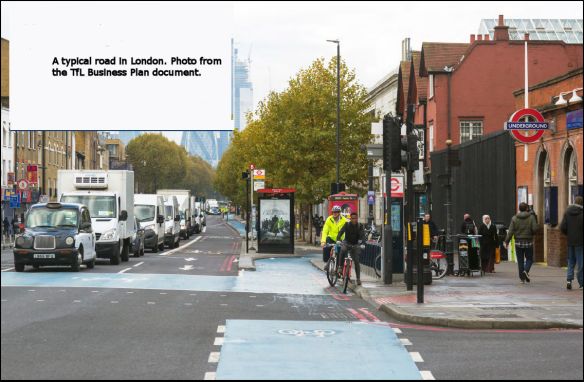
A good example of the result of his policies is actually shown in a photograph of an east London street in the Business Plan document. A long queue of traffic in one lane with the bus lane unused and few cyclists in the cycle lane! See above.

Roger Lawson

Twitter: https://twitter.com/Drivers_London

You can “follow” this blog by clicking on the bottom right.

Why Cost/Benefit Analysis Is So Important

The world is becoming full of irrationality. Political decisions seem to be driven more by emotion than by science of late and all we see on television news are human interest stories rather than facts and analysis.

This creates an atmosphere where those who shout loudest are listened to while quiet scientific analysis is dumped. Thus organisations such as Extinction Rebellion get lots of publicity and media personalities such as Greta Thunberg get massive coverage however wrong they are.

But emotions drive bad decisions.

Let’s consider the issue of road safety for example. Everyone recognises that there are still too many deaths and serious injuries on our roads, many or which might be avoided. But if we decide this is a major national priority on which money should be spent (i.e. from taxes), where do we spend it? A rational person would say “spend it on the most cost-effective proposals because that way we will save the most lives or injuries for a given amount of expenditure”. Bearing in mind there are limited financial resources in any Government, this has to be the best approach.

But there are various ways to reduce casualties, which includes:

  • Redesigning roads to make them safer, including tackling known blackspots.
  • Improved driver training and tougher tests for new drivers.
  • Improving in-car safety by better engineered vehicles.
  • Improving emergency medical treatment after an accident.
  • Cutting ambulance response times.
  • Reducing traffic speeds that might reduce casualty severity.
  • Exhortations to drivers to take more care with publicity campaigns.

You can probably think of some others that might help but the first four of the above have probably had the most impact in the last few years on casualty reduction. Where should the money be spent? What provides the best cost/benefit ratio is the answer.

At the lower level, if we decide that money spent on improving roads is worthwhile, then where do we spend it? The answer is again simple – on those locations where the money will save the most casualties. But many local councils ignore that approach and simply listen to local pressure groups.

Or at the higher level, should the Government spend money on road safety, on improving hospitals, or on improving home safety. For example about 1,700 people die in road accidents each year in the UK, but there are about 6,000 deaths each year from accidents in the home, and 40,000 deaths from cancer. The latter might be susceptible to more expenditure on treatment or research, while many home deaths are due to falls down stairs. Should the Government invest in lifts for all multi-storey homes or only allow bungalows to be built in future? Some 55% of injuries in the home are burns caused by cooking. Should the Government ban cooking?

You can see how this whole field is a minefield of conflicts of interest and instead of rational analysis people tend to spend money where they think it might help or based on traditional ideas. But the answer is to evaluate the cost versus the benefit on a simple uniform financial measure.

The benefit of saving a life, or a serious injury, can be valued and the Department for Transport regularly publishes their figures for those costs – currently it’s about £2 million for a fatality, £250,000 for a serious injury and £25,000 for a minor injury. One can dispute how it is calculated and how optimistic or pessimistic that figure is, but it does provide some basis for working out how much should be spent on saving a death. In addition there are many more minor accidents than KSIs (about 100 times the fatalities), and minor accidents are easier to value because you can simply add up the medical treatment costs, the lost employment time, the emergency services costs and then ask the victims how much they would have paid to avoid the injury. So the overall costs can be roughly estimated with some accuracy.

A similar calculation is made for many other purposes – for example, what is the benefit of treating a patient with a life saving drug versus its cost? Or how by how many years will their life be extended and how do you value an extension of life? Such calculations are a regular element in public policy decisions, although there are few hard guidelines on the subject at present.

The above indicates how the benefits might be calculated. To offset those one has to work out the costs. That includes in the case of revised road schemes, the construction cost of course, but there are often costs (or savings) imposed on road users. For example, in the recently discussed case of the Chislehurst War Memorial Traffic Lights (see https://tinyurl.com/y56v2rty ) where it was proposed to install a Pelican Crossing, the costs are not just the construction cost but the on-going costs imposed on the road users by the extra delays and traffic queues of having a pedestrian phase in the lights. In addition there are the negative costs of more accidents on minor roads due to traffic diversion to avoid the jams, and more air pollution from the stationary queues of traffic. These can all be estimated.

On the subject of air pollution, we currently have a lot of debate about the impact of that and what should be done to improve it. But there is typically little cost/benefit analysis. In reality, even if all air pollution was removed (an impossible task as a lot of it comes from natural sources), it might only extend the average population life by a few days. Meanwhile in London alone hundreds of millions of pounds of costs are being imposed on residents in the name of solving the problem. The cost/benefit on the ABD’s calculations for the London ULEZ scheme is extremely negative – see https://tinyurl.com/y4w6pwuk for the figures. Even Birmingham Council produced a negative figure when trying to justify their CAZ scheme but they still decided to go ahead.

This is public policy making turned on its head. The fact that both such schemes will generate large amounts of revenue for the Mayor of London and Birmingham Council was perhaps a more important part of their considerations! These “taxes” are an irrational imposition on the public and are not even an efficient way of collecting taxes.

Transport for London (TfL) have even given up on publishing any cost/benefit analyses of most new road schemes mainly because the figures when calculated show that they are simply uneconomic. Or they publish figures that are distorted by not including all the costs – for example on their “Safer Speed” plans.

Public life is being corrupted by the approach of relying on emotion to make decisions or by other motives rather than on a proper cost/benefit analysis. We need more politicians who are better educated and understand these issues, and the general public also needs to become better informed on these matters.

Roger Lawson

Twitter: https://twitter.com/Drivers_London

You can “follow” this blog by clicking on the bottom right.
Latest Political News in London and Beech Street Closure

This is the news that might have some impact on transport and political issues in the capital:

The former Conservative Leader on the Greater London Assembly (GLA), Gareth Bacon, has been elected as a Member of Parliament for Orpington and hence is stepping down from the GLA. He was forceful in challenging the Mayor on his policies. The new Conservative Leader will be Susan Hall who from following her on twitter and meeting with her, I judge should be just as forceful if not better. See  https://www.glaconservatives.co.uk/susan-hall.html for more information.

Because Boris Johnson has opened a new Parliament, he has made changes to some ministerial appointments. Included in that is the appointment of Chris Philp, MP for Croydon South, as Minister for London – that’s in addition to his role at the Ministry of Justice. This is what he had to say in the Evening Standard:

“Londoners are sick of Sadiq blaming others for his failure to deliver — there is no excuse for housing starts in London falling at a time when they have been rising in the rest of the UK and when billions of pounds of public money have been provided for housing.

I am deeply concerned at the delays and cost over-runs on Crossrail and of course we all need to work together to clamp down hard on knife crime, as well as its underlying causes.”

Mr Philp described himself as a “Londoner born and bred” in the article and added: “With more than 300 languages spoken in London alone, it’s bursting with diversity which we must embrace.”

Sadiq Khan has already accused him of having an “aggressively partisan attitude” so that should get him off on the wrong foot with the new Minister which he needs to persuade if his plans are to get anywhere. That includes more money for London which he has been asking for, particularly for transport, when the national Government policy might now be just the opposite with more money going to the North as a reward for voting Conservative. He also wants to grab more power in a number of areas which I doubt the new Government will be keen upon. Sadiq Khan is like a lot of Labour politicians in that he thinks more money is always the answer when in fact mismanagement of his budget is the real problem. More information on Chris Philp is present here: https://www.chrisphilp.com/about-chris/

Now that we have a Conservative Government with the ability to put through legislation without endless debate we might even see a reform of the GLA and the Mayor’s role which are both sorely needed. That would be rather like Mrs Thatcher putting Ken Livingstone out of business by disbanding the Greater London Council (GLC) in 1986. Unfortunately the Labour Party put in the current structure of a directly elected Mayor and the GLA (which is purely a talking shop) in 2000. Reform is sorely needed as the Mayor is unaccountable to anyone and acts like a dictator. His transport policies are destroying London and imposing enormous costs on the public – for example he has just announced a rise in the GLA precept in Londoner’s Council Taxes. Financially his regime is a disaster and crime is totally out of control.

London does not need populist Mayors such as Ken Livingstone or Sadiq Khan who simply seem to want to ensure they get re-elected. We need someone with both management and financial experience, which incidentally Chris Philp certainly has from my contact with him on financial issues. He should be a good Minister for London as he has always appeared to me to be highly intelligent.

Other London news that was widely reported was that the City of London is pushing ahead with a scheme to close Beech Street to all vehicles other than zero emission ones. This would apply for all hours for all days from next April, and to all vehicles with a few exceptions.  Beech Street runs under the Barbican and has very high pollution as it is effectively a tunnel with no ventilation. The City Corporation is also proposing to put in later two zero emission zones around the Barbican estate and north of Fenchurch Street.

One thing the new London Minister might care to look at is stopping London boroughs and the Major or London from introducing regulations and taxes which are contrary to national regulations without his consent. The Beech Street restriction is unnecessary, unreasonable and the minor air pollution problem in that road could have been solved by other means.

Roger Lawson

Twitter: https://twitter.com/Drivers_London

You can “follow” this blog by clicking on the bottom right.

Cutting Rail Fares by One Third

The latest bribe to the electorate from the Labour Party is a promise to cut rail fares by one third. This would be financed by diverting income the Government receives from Vehicle Excise Duty to the railways.

Motorists already pay much more in taxes than are spent on the roads (see https://www.abd.org.uk/road-investment-and-road-user-taxation-the-truth/ ). Railways have been massively subsidised ever since they were nationalised in 1947 – the “privatisation” of the railways has had little impact on that although rail passengers have been paying relatively more of late so as to finance improvement in the infrastructure.

Diverting VED tax to subsidise rail passenger fares will mean big cuts in spending on the roads, leading to even worse traffic congestion. Meanwhile reducing rail fares by one third will have very perverse effects. For example in London and the South-East it will lead to even more long-distance commuting as rail passengers find it cheaper to travel from far afield into the capital.

In summary this proposal is just bonkers economics as resources are diverted on irrational grounds.

Why should rail passengers not pay the real cost of their travel? Anyone who thinks their cost of using a car should not subsidise unrealistic train fares now knows who not to vote for in the General Election.

Twitter: https://twitter.com/Drivers_London

You can “follow” this blog by clicking on the bottom right.


Shepherds Bush and Kensington Consultation Responses and TfL Budgets

The Mayor and Transport for London (TfL) have published the results of their consultation on proposed changes to roads in Shepherds Bush and Kensington (Wood Lane, Notting Hill Gate, etc). The proposed changes will increase journey times for road users and hence also increase congestion – see https://tinyurl.com/yzxhb9m8 for our original report. As one person commented on that article: “Another example of the Mayor’s determination to punish the motorist under the misguided ploy of improving air quality. This latest proposal will in fact worsen air quality by delaying traffic flow”.

The TfL Consultation Report also correctly quotes our comments on the consultation where it says we “Was very critical of the online consultation material, branding them a ‘disgrace”. There were no costs given for the scheme and the questions were biased to get the required answers.

There were 5,386 response to the consultation and many people agreed that it would encourage cycling, walking and use of public transport. That’s hardly surprising is it when they realised that private vehicles will be delayed.

The consultation was also biased because there were 58,539 emails sent out to people asking them to respond but it was only sent to “people who use public transport or cycle in the area”. In reality Oyster Card and Contactless customers, so private vehicle owners were excluded.

Even with all this manipulation, they still managed to get 2,151 people who argued that the proposals would cause traffic congestion or delays, and 1,565 people who said the proposals would worsen air quality. There were also particular concerns about the Holland Park area and the removal of trees.

The London Borough of Hammersmith & Fulham supported the proposals but Kensington & Chelsea borough have objected. TfL have developed revised proposals which include saving more trees and discussions are continuing. At least this shows how strong local opposition to a scheme can cause TfL to reconsider. But the whole process of TfL consultations is ethically flawed.

You can read the TfL Consultation Report here: https://consultations.tfl.gov.uk/roads/wood-lane-notting-hill/ 

Crossrail delays and TfL budget impact

Other news is that TfL have announced that Crossrail (the Elizabeth Line) opening date is to be delayed yet again and it not going to open until 2021. It was originally scheduled to open in 2018. Problems with signalling systems seem to be the cause, and costs are ramping up so it is now likely to come in at over £18 billion. This demonstrates how large rail projects are enormously expensive and are approved with over-optimistic budgets and projected timescales. This is why HS2 should be cancelled now before even more money is wasted on a scheme with a poor cost/benefit ratio.

The additional delay to Crossrail opening will result in another big hole in TfL’s budget because there were many millions of pounds of income expected from fare paying passengers on the new line.

But TfL have devised one way to improve their cash income. They are changing the auto top-up level for Oyster Card users from £10 to £20. This will mean that TfL will be holding much higher balances of customer money than before. The exact impact has not been disclosed but I hope to report more information on this at a later date.

Twitter: https://twitter.com/Drivers_London

You can “follow” this blog by clicking on the bottom right.

ULEZ Revenue and Benefits – Not As Expected

ULEZ SignTransport for London (TfL) have released some figures for the first six months of the ULEZ scheme (for April to September 2019). The bad news for the Mayor is that the income from the scheme in fees paid by non-compliant vehicle owners and penalty charges is much less than expected.

There was revenue of £31 million from charges paid (12.50 per day for cars, vans and motorcycles and £100 for HGVs and buses). Plus there was £11 million from penalty charges. One driver managed to collect 81 penalty charges but otherwise it is the typically high figure you see from camera enforced schemes where many people don’t realise they have entered the charging zone or forget to pay.

But the overall income of £41 million, equivalent to £82 million per annum, is much less than originally anticipated. Income in the first year was originally estimated to be £174m and costs £47m, producing a surplus of £127m. So the surplus is likely to be a fraction of that originally anticipated at only £35 million. See https://tinyurl.com/y4w6pwuk for the original estimates.

It would seem likely that more vehicle users than anticipated have switched to newer vehicles with the proportion of non-compliant vehicles falling rapidly to only 25% in September. The overall number of vehicles also appears to be falling. The low numbers of non-compliant vehicles means that the income will also fall substantially in the second half of the year thus reducing even further the anticipated surplus so it could be much less than even £35 million. This will put yet another hole in the Mayor’s financial budget for TfL which is already in a dire state.

The good news (at least for those who believe that NOX air pollution is a major health hazard – we do not), is that NOX emissions from road transport in the central zone are estimated to have fallen by 31%. That is probably consistent with the original estimates that there would be a fall in NOX emissions of 17% by 2021 as only about half of such emissions come from road transport and such emissions are falling rapidly anyway as the vehicle fleet is renewed.

Only a small reduction in CO2 emissions is reported, and no figures on particulates (PM) are yet reported. You can read the full TfL report here: https://tinyurl.com/y2h63dxc

We still believe that this is a very expensive scheme that is imposing enormous costs on many vehicle owners with very marginal benefits in terms of air pollution. It is unclear whether NOX actually has any negative health impacts – see our report here that covers the air pollution issue in depth: https://tinyurl.com/yx9bk9kg . We would also like to see some actual measurements of NOX rather than just estimates.

There has never been any proper cost/benefit justification for this scheme but the Mayor no doubt saw it as a means to plug the holes in his TfL budget with the ULEZ tax. In reality it’s going to raise a lot less than anticipated.

Readers should make sure they oppose the expansion of the ULEZ to the North/South Circular in 2021 which will cover many more people.

Twitter: https://twitter.com/Drivers_London

You can “follow” this blog by clicking on the bottom right.

Sadiq Khan’s Election Manifesto – Have Your Say

The Labour Party are inviting everyone to have their say on Sadiq Khan’s Manifesto for re-election as London Mayor in 2020. You can read about his achievements to date and submit answers to their questions via this web page: https://tinyurl.com/y29yu999 . It is of course a very biased document like all consultations that Mr Khan presides over, but anyone can respond – you don’t need to be a Labour Party member.

Perhaps the Mayor is short of ideas to ensure he gets re-elected. His last big vote winner was freezing public transport fares but after three years of holding the tide back of inflation in King Canute fashion he has managed to dig a deep hole in Transport for London’s finances which simply cannot continue. Bus services are being reduced as a result while traffic congestion increases. His policies on Congestion Charging and the ULEZ will impose higher costs on many Londoners with minimal public health benefit. He has also clearly failed to tackle rising violent crime and not solved London’s housing problem – indeed his only proposal for the latter is to introduce rent controls which would make matters worse.

But he does admit to increasing the Council Tax Precept (what you pay to the Mayor from your local council taxes) to the maximum allowed. No thanks Mr Mayor. All his other claimed achievements are quite trivial in relation to the problems Londoners perceive as key issues.

All the way through the document, the Mayor emphasises that he has limited powers over many aspects and clearly wants more. But it would be very dangerous to give him more.

Here are some of the questions and how you may care to respond to them (I have only covered those questions that are relevant to transport):

Environment and Climate Change:

Question: How do we take the next steps to clean up London’s air and oversee a massive shift from polluting cars to walking, cycling and electric vehicles at the same time?

Answer: concentrate on fixing the vehicles over which you have control and which are major contributors to air pollution, i.e. diesel buses. You also need to tackle air pollution on the Underground. Otherwise any measures should be justified on cost/benefit grounds and scare-mongering over an imaginary public health crisis as the justification for higher taxes should be stopped. The expansion of the ULEZ to the North/South Circular should be halted and the introduction of more Cycling schemes that create more traffic congestion (and hence air pollution) should be halted.

Transport:

Question: How else can Sadiq make London’s transport system affordable and accessible to all Londoners?

Answer: Stop wasting money on schemes with very poor cost/benefits (such as the proposed Rotherhithe bridge and most of the Cycle Superhighways the finance for which has to come out of public transport fares. He needs to stop spending money and imposing taxes on road users to make the transport system more affordable for everyone. That includes halting the investment in 20 MPH speed limit schemes and cycle schemes that have poor cost/benefits. He should also cease support of road-pricing and workplace parking levies.

Question: What are the future major schemes that Sadiq could focus on delivering?

Answer: The Silvertown Tunnel is one which will be a major benefit for east London. Repairing the Hammersmith Bridge is another for West Londoners. Improving major east-west and north-south road routes such as the Embankment rather than degrading them with 20 MPH speed limits and cycle lanes should be another key objective.

Question: What more can be done to promote walking and cycling?

Answer: Some youth elixirs for the elderly and inform would help and concealing the dangers or cycling is another. That is of course just a witty response to a proposal that is unnecessary and has major disbenefits.

Question: When asking for more powers and devolution from Government on transport issues, where should Sadiq focus his energies?

Answer: Give the Mayor powers to introduce policies to reduce the population of London so as to reduce pressure on the transport, housing and public health systems. Specifically redistribution of business and people out of London and powers to reduce immigration and encourage birth control.

He should also argue for a commitment to devolve more powers to local boroughs so as to avoid TfL dictating local borough policies and more funds financed by central Government to be given to local boroughs solely to be used on improving the road network in London. In addition the Mayor should be given the power to set sensible minimum parking standards for new developments (not maximum ones) in London boroughs.

Those are just a few ideas to help Mr Khan, or indeed his opponents, to get elected.

Twitter: https://twitter.com/Drivers_London

You can “follow” this blog by clicking on the bottom right.

Highway Robbery and Leaving London

Highway Robbery CoverGareth Bacon, Conservative Leader on the Greater London Assembly, has published a most interesting document entitled “Highway Robbery – The Case Against Road Pricing in London”.

He makes the case very well and argues that Londoners should have a wide choice about the modes of transport that they use and that car journeys are quite essential for many trips in outer London. He highlights that Mayor Sadiq Khan may be looking at road pricing simply as another way to fix his TfL budget problems.

But it would undoubtedly lead to much higher costs on vehicle owners – perhaps 70% more than they pay in taxes at present very little of which is spent on the road network. Meanwhile public transport users in London are subsidised by over £1 billion per annum. Mr Bacon suggests the Mayor should rule out road pricing in London while committing to spend more on London’s roads. In particular he supports the Mayor’s claim that some of the VED tax paid by London’s drivers should be given to the Mayor but only on condition that it is hypothecated to spend on road maintenance.

We have opposed Sadiq Khan’s stated wish to grab some part of the VED tax take as it might give him control of it and lead to higher tax rates for no benefit. But if it was strictly controlled by the Government on the suggested basis it may be more arguable. But will central Government and the public accept that less money is thereby available to spend on the national highway network?

Surely it would be better to cut out the excessive bus subsidies and the over-generous concessionary fares (payable to everyone even when they can afford the cost) which would easily pay for improved maintenance of London’s roads?

You can read the “Highway Robbery” report here: https://www.glaconservatives.co.uk/uploads/1/1/7/8/117899427/highway_robbery.pdf

Leaving London

Record numbers of people are leaving London according to a report by the Office of National Statistics (ONS). In 2018 some 340,000 residents left London while 237,000 moved in meaning a net loss of 103,000. The national press attributed this to high house prices and a fear of crime. No doubt they contributed but perhaps the congestion on the roads and on public transport is also making London a less pleasant place to live while car owning and public transport costs are rapidly rising.

Sadiq Khan seems to be making matters worse rather than fixing them. The report mentioned above shows some of the negative aspects of what he has done and what he is planning to do. That is surely contributing to Londoner’s giving up on the capital for a better life elsewhere.

Roger Lawson

Twitter: https://twitter.com/Drivers_London

You can “follow” this blog by clicking on the bottom right.

Silvertown Tunnel Goes Ahead

Transport for London (TfL) have named the Riverlinx Consortium as the preferred bidder for the Silvertown Tunnel. This is the new tunnel to relieve congestion at the Blackwall Tunnels, something that has been desperately needed for some years.

The Consortium is a private finance project backed by several investors. They will get the build costs and the initial maintenance costs from a toll on the users of the both the Silvertown and Blackwall Tunnels. Some vehicles will also be paying an additional ULEZ charge because the tunnels will fall within the expanded ULEZ area.

TfL say they do not have the funds to finance such major projects despite the Mayor of London having an annual budget of over £18 billion, one of the largest for any municipal organisation in the world. Relying on private finance initiative funding has been shown to be one of the most expensive ways to provide public infrastructure in the long-term so this is probably another example of Mayor Sadiq Khan’s financial ignorance. Perhaps it’s a case of TfL being unable to borrow the money to finance the project as they are beginning to look like a basket-case of the first order.

The new tunnel should substantially reduce congestion and cut air pollution from the queuing or standing traffic that happens most days at present. The build contract should be formally awarded in the summer, with completion by 2025. But the Green Party are still opposing it.

Roger Lawson

Twitter: https://twitter.com/Drivers_London

You can “follow” this blog by clicking on the bottom right.